Hybrid Publics: Art Between City and Stack
The collective Clusterduck in Zurich
Art in public space has always faced the challenge of having to constantly reinvent itself. Yet in the digital age, this challenge is more pressing than ever: how can art be defined when public space itself becomes a hybrid entanglement of physical locations, digital networks, and algorithmic logics?
It is precisely against this backdrop that the artist collective Clusterduck currently positions itself with their project The (W)hole, on view in Zurich. In their exhibition project, Clusterduck addresses the omnipresent yet elusive presence of technical structures. They translate these into installations and scenarios that can be experienced in urban space. And to do justice to the technological complexities of our contemporary lifeworld, The (W)hole presents itself not as a clearly delineated sculpture, but as a complex, multilayered ensemble.
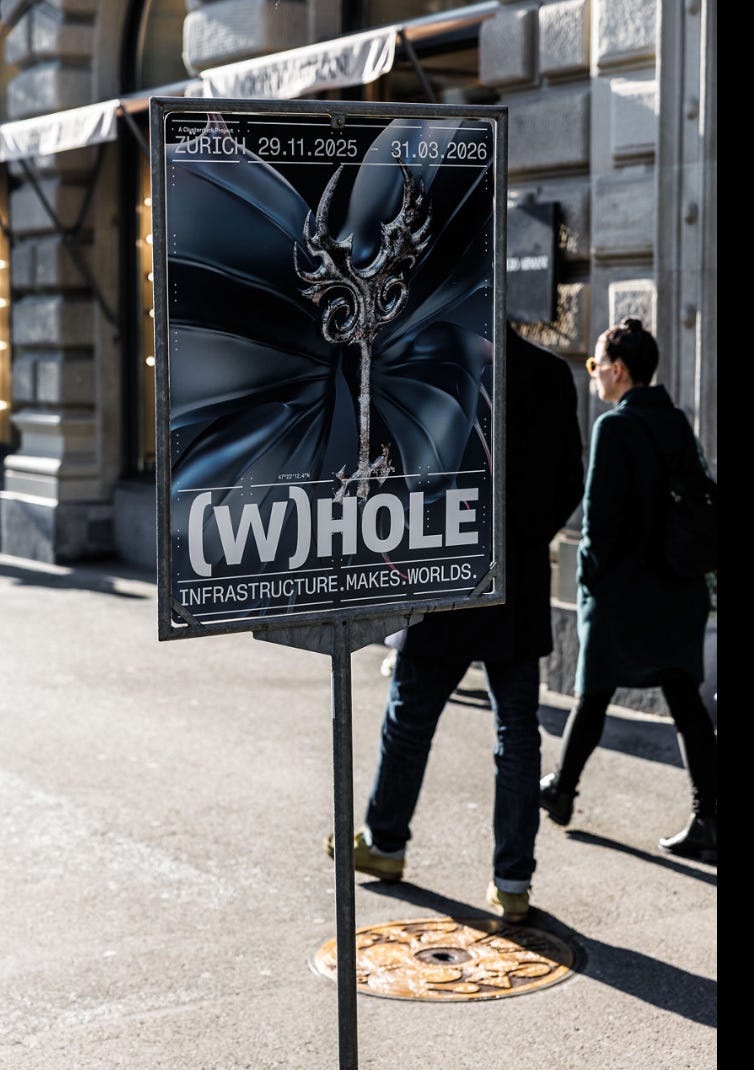
The starting point for Clusterduck is the concept of the “Stack” developed by theorist Benjamin Bratton. Bratton understands the “infrastructure” surrounding us — shaped by digital technologies — as a complex arrangement divisible into six layers. The layers Earth, Cloud, City, Address, Interface, and User each represent specific functional structures. They refer to elements that we can sometimes personally appropriate and survey — such as the city — as well as those that fundamentally elude our grasp, such as the Cloud. Clusterduck thus adopts the concept of the Stack to point to the comprehensive expansion of our lived realities through contemporary digital technologies.
As entry points or portals for visitors, they developed six artistically designed manhole covers, placed at neuralgic points throughout the city of Zurich that reference Bratton’s layers. They further deepen the content of each on-site layer through augmented reality scenes accessible via QR codes. In doing so, they create multidimensional experiential spaces on location — spaces intended to make not only a complex theory, but technological lived realities, tangible.
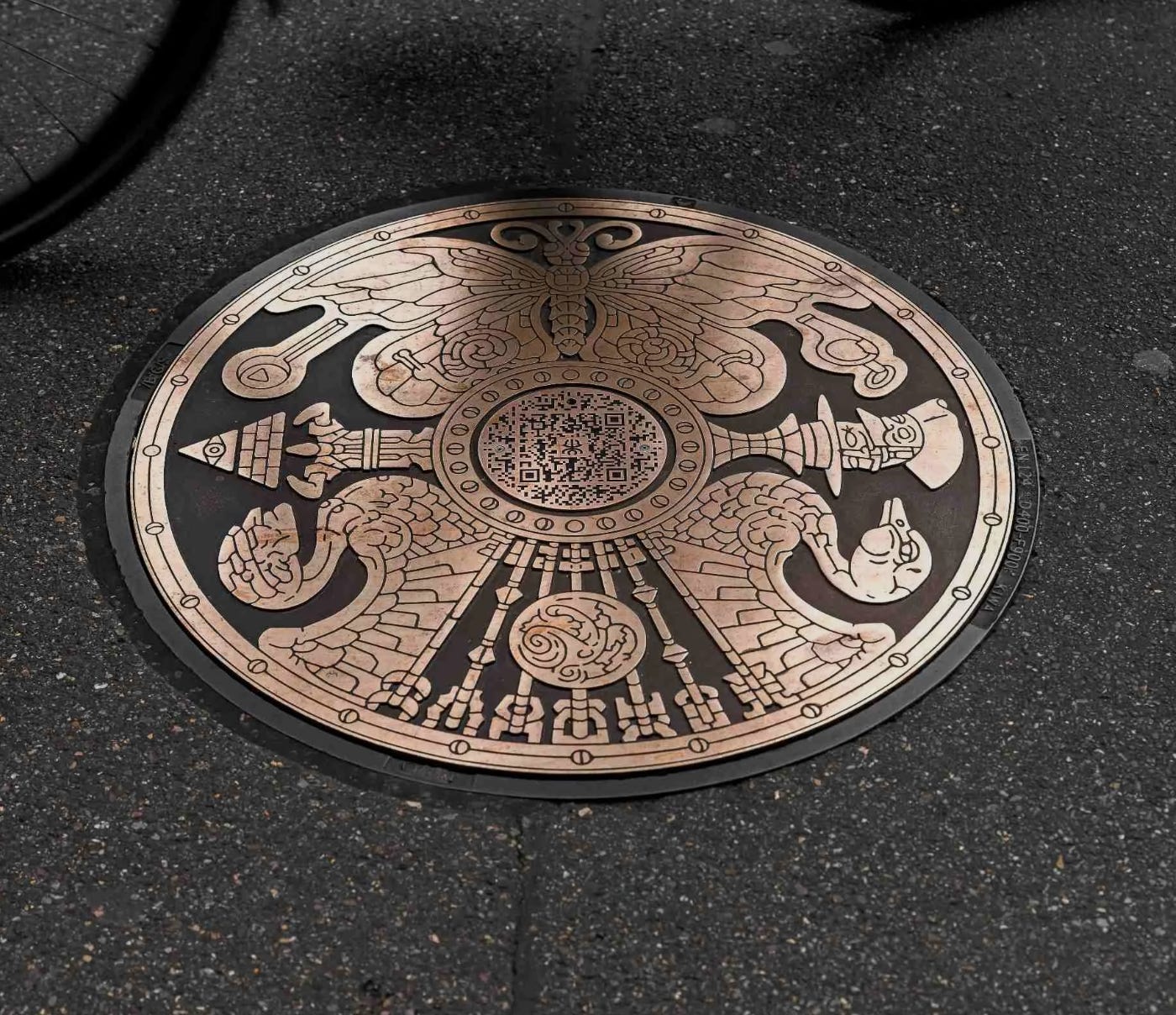
Bratton’s theories are not simply adopted, but in a sense transposed into mythological references. The manhole engravings designed by Jules Durand allude to phenomena that are as real as they are consequential — such as surveillance and gentrification — while also bringing to mind demonic figures or the white rabbit from Alice in Wonderland. Through the manhole covers and the augmented reality scenes, the artists develop narratives that render the city of Zurich and the technologies shaping it as an almost fairy-tale-like complex scenery waiting to be discovered.
All of these layers are ultimately brought together on a webpage. This serves not only as an informational tool explaining the background of the individual engravings, but is intended to be activated as a “Living Archive” as the project develops further. The project website features a database pointing to texts and documentation, making scholarly and documentary contexts accessible to visitors. As the project evolves, this database is to be opened up for contributions from visitors. Through their web presence, Clusterduck makes clear that they aim not only to generate techno-aesthetic experiences, but also to convey foundational knowledge about the subject they have engaged with and to activate local knowledge.
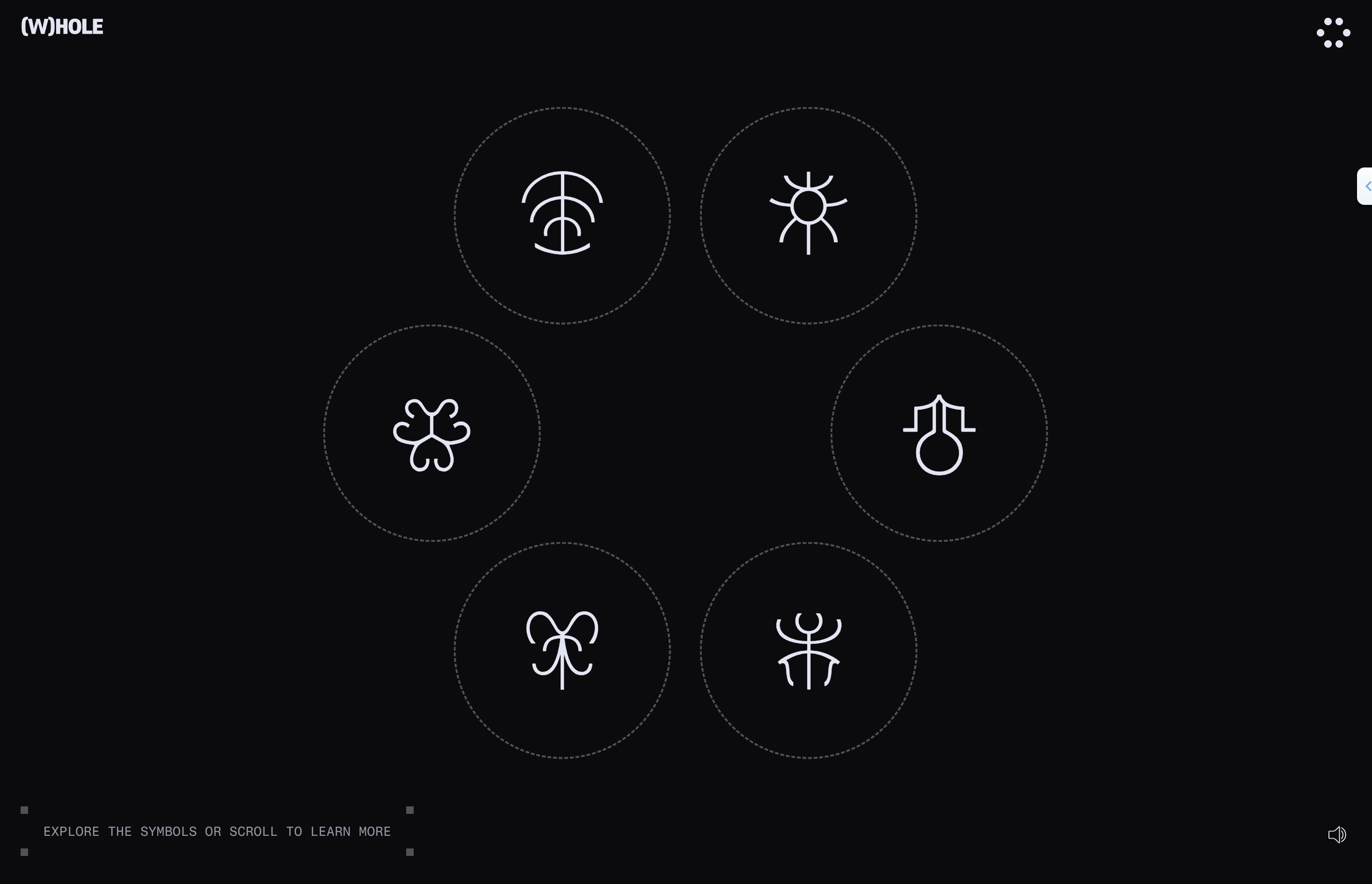
The project website thus reveals the fundamental attitude that permeates The (W)hole: digital culture, as Clusterduck demonstrates here, is a collective phenomenon that can be activated both socially and aesthetically. In The (W)hole, the artistic object intertwines with the research question, the archive with the narrative, the exhibition with the platform. The work creates no closed spaces, but forms an experimental ecosystem that comes alive across various modes of access.
The project is thus positioned by the artists in a way in which art, research, digital infrastructure, speculative fiction, and collectively organized knowledge production become inextricably interwoven. The very title of the project hints at this multilayered quality: The (W)hole is simultaneously an exploration of the whole and an engagement with the holes, cracks, and abysses from which the digital emerges.
This approach is relevant because, historically, art was primarily bound to physical spaces — museums, churches, or public squares. Digital technologies have broken down these boundaries. They create new forms of the public that are no longer tied to place. Clusterduck thereby makes comprehensible that art today can also be received and produced through social media, digital platforms, and virtual networks. The artist collective thus points to transformations that concern not only the reception of art, but equally our very perception of space itself.
They do so at a moment when it has not yet been definitively established what significance digital technologies will hold for public space and for public art in particular. At present, constellations of power are constantly shifting within the context of the digital public; new “forums” are opening up within ostensibly neutral network technologies that have yet to be fully understood. If one takes seriously the current transformations of the public through digital technologies, the local presence of art is called into question. After all, we as recipients are by now without a fixed location ourselves. The internet accompanies us permanently, yet largely remains invisible: server farms are mostly located outside of cities, platform architectures elude perception, data streams remain closed to our senses.
Against this backdrop, The (W)hole unfolds, consequently, in a process of sense-making that connects the city: knowledge is conveyed here not linearly, but fragmentarily, interwoven, and open to expansion. The work links everyday urban life with the deep layers of the digital. It transforms places into speculative infrastructures. At a time when digital technologies are increasingly receding into the background while simultaneously remaining omnipresent, The (W)hole enables a rare, almost poetic experience: the moment when the invisible suddenly takes shape in urban space. Clusterduck's project is thus not placed in public space, but generates experiences of the public itself — as an ongoing process within the tension between city, art, technology, and their users.