future-machines

Writing on contemporary (media) art, digital culture, and the technological condition of the present. By Dr. Heiko Schmid

Photography and video, in their technical resolution, are reference media of our time. We have grown accustomed to photography as daily reality: digital storage media and the almost unlimited visual access to our environment afforded by smartphone cameras have made photography and increasingly video our permanent companion. What is less apparent in everyday life is that in the course of this process, the way images come into being has itself changed profoundly. The images and videos that circulate dominantly today are no longer classical products of the technical output of a camera obscura; they are results of computational processes. These images are no longer drawn by the mere incidence of light, by a “pencil of nature”. Instead, “image machines” are assembled from data. These machines negate the classical order of objectivity in both senses of the word: its reference to objects and its claim to intersubjective validity. The thesis of this essay is that with these pictorial image machines an order is coming to an end that has governed our pictorial imagination and with this our concept of the world for centuries: the order of central perspective.

To explain this claim, it is necessary to take a step back. Photography and video as we know it today builds, in terms of cultural history, on the camera obscura and the associated concept of central perspective. Both the camera obscura and central perspective organize representations, technically as well as conceptually, around a central axis of vision. What is seen is made visible from a single point, as if through a peephole. In this respect, central perspective in particular is a foundational instance of European art history. And central perspective did not merely organize images; it organized the world and perception, as Erwin Panofsky classically argued in Perspective as Symbolic Form. It was meant to make what is to be seen around us geometrically, and thus objectively, describable. The following illustration by Leon Battista Alberti, who first codified central perspective in De pictura (1435), shows well how this was done.
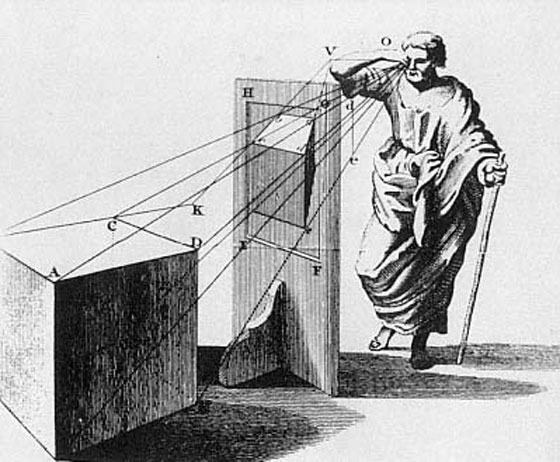
Bildbeschreibung Leon Battista Alberti, “Illustration”, 1435.

This illustration quickly makes clear that things are here opened up and explained from the perspective of a beholder. The world here emerges from the perspective of an idealized, posited gaze. It is organized accordingly into different layers of depth: into foreground, focused image centre, and background. Central perspective is essentially a mathematical system of rules that helps us categorize the world as a pictorial construct.
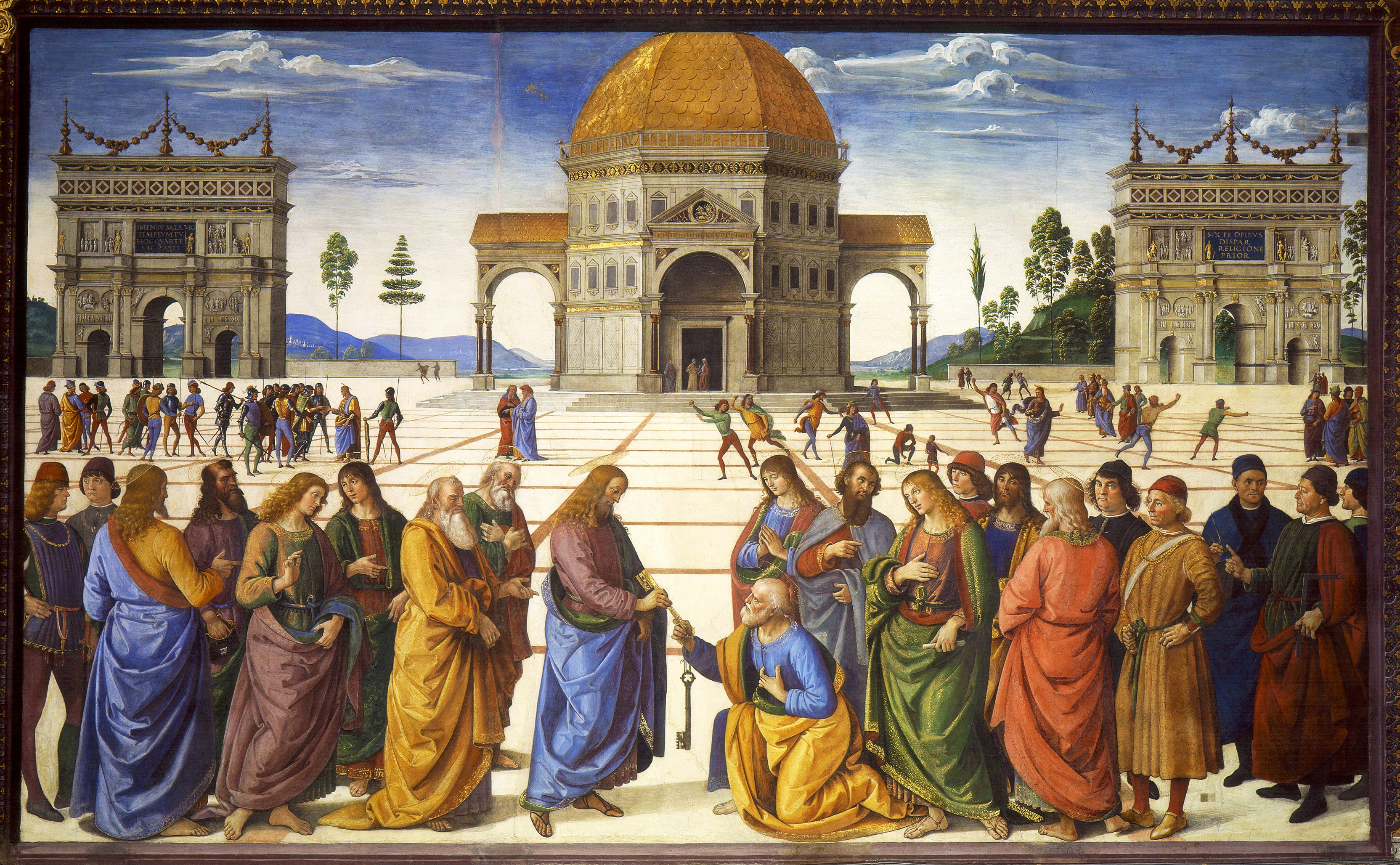
Bildbeschreibung Pietro Perugino, Consegna delle chiavi, 1481 – 82.

In terms of cultural history, the central perspective is not only relevant for artists – it is a tool for describing the world. The emergence of the European natural sciences can also be linked, in terms of the history of mentalities, to the central perspective. Crucial to the natural sciences, too, was the experimental order of an “as if,” in which personal perception was not merely to be described but made verifiable. The term “objectivity” nicely reflects what resonates here. If we bring into view only the objects themselves, as they unfold before us in perspective, then intersubjective positings become possible – and with them, assumptions of truth. And the efficacy of these assumptions of truth for European as well as global cultural history can hardly be overestimated.

At this point, I have to make a leap. In terms of cultural history, there would be numerous further points to raise here, which cannot be accomplished in an essay that ultimately places contemporary phenomena at its centre. My primary concern here is to mark out a historical context. May I be forgiven, then, for now, jumping almost directly into the present.

Cybernetics With the emergence of cybernetics and the digital tools it made possible, the way we appropriate our world changed profoundly. The latent spaces of the data realm are the multidimensional feature spaces in which computerized machines internally organize what they process. This information-based digital space of computerized machines does, superficially, build on structures similar to those of the classical world-space spanned by central perspective. However, and here lies the central difference, it no longer builds on objective conceptions of world, but places information, or rather digital representations of “things,” at the centre – representations that no longer commit themselves primarily to a referent in the world.

The things of the present, so it can be claimed, are no longer parceled out in central perspective within our image-making but are appropriated, categorized, and stored as units of information by our current digital technologies. Following this development, photographs and videos in particular have, since the late 1990s, become digitally de-objectified objects. This dynamic became accessible to the general public at the latest with the emergence of computer programs such as Photoshop. With the help of such programs, it became possible to intervene retroactively in images, that is, in their informational basis. At the same time, a broad public came to understand to what extent the computerized data space had begun to transform our very concepts of reality. To be clear, photographs could always be manipulated – retouching and montage are as old as the medium, as John Heartfield’s photomontages demonstrate. What was categorically new is that digital images consist of nothing but their manipulable informational basis: intervention no longer worked against the image; it became its mode of existence. Since then, we have been living in what Jean Baudrillard called a time of simulacra (Simulacra and Simulation, 1981). Simulacra, in Baudrillard’s sense, are signs that no longer conceal a truth behind them but take its place – copies without originals. We experience a time emptied of objective assumptions of truth – one that can be permanently overlaid by categorizations and interventions from the computerized information space.

And constant access to the informational basis of the “world-images” that surround us and that we produce has long since become normality. A digitally produced image today hardly differs, superficially, from its analogue counterpart. Various artists, however, have adapted aesthetically to this new “reality.” The photographs of Andreas Gursky, for instance, have shown well since the early 2000s that precisely the classical division into foreground, image centre, and background need no longer play any role for digital photography. His by now classic depictions show hyperreal sceneries; they show multiperspectival ruptures that no longer have anything to do with analogue photography.
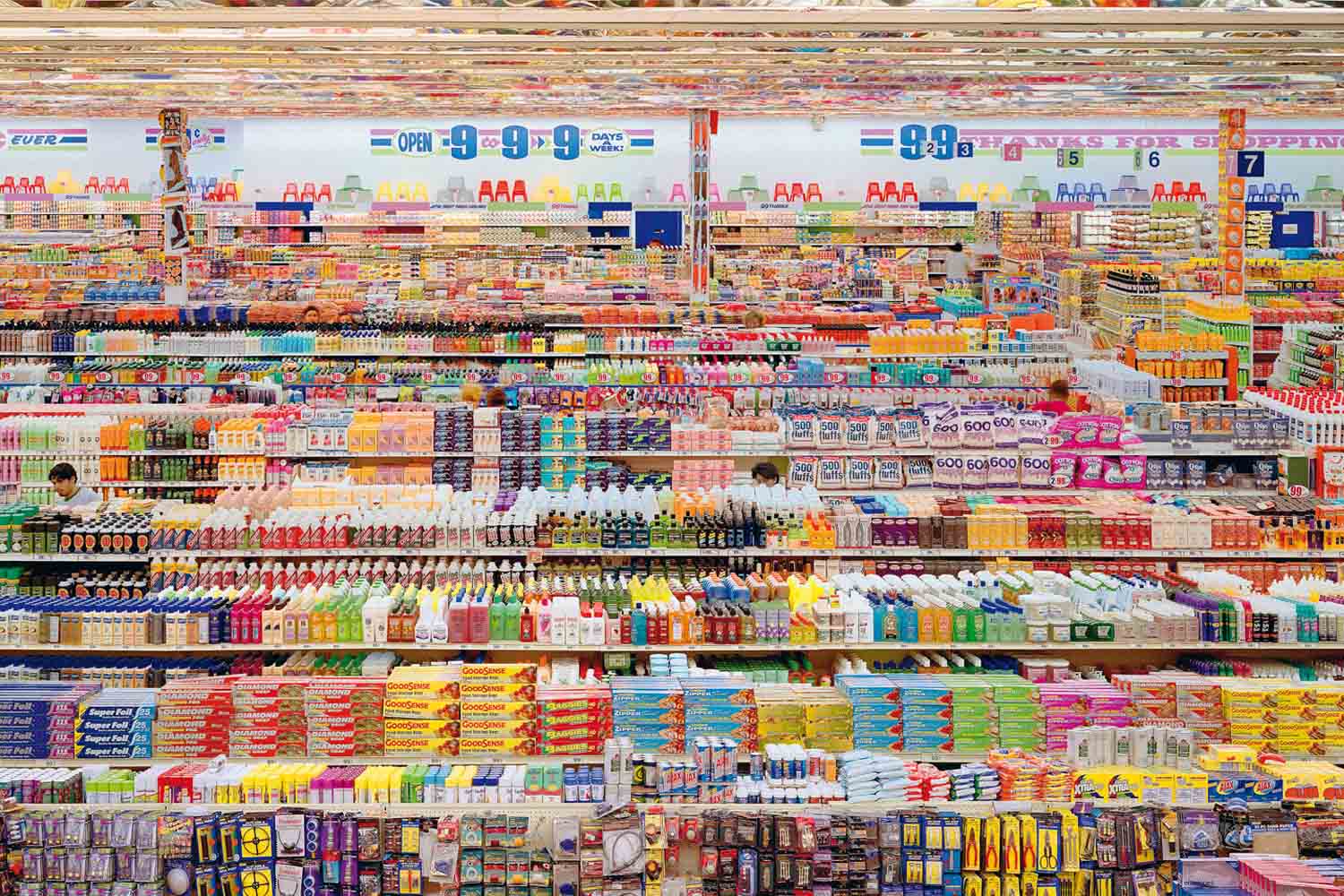
Bildbeschreibung Andreas Gursky, 99 Cent II, Diptychon, 2001.

What this means can be shown using the example of 99 Cent II, Diptychon. In this artwork, there is no clear image centre, but only, as it were, clustered, superimposed image axes. Here everything is meant to be visible without restriction – no ray of light and no axes of vision organize our gaze. The organization of the image migrates into image-immanent systems of reference that show everything and no longer focus on anything. These images thus dissolve, as it were, into information. They present themselves as compositions perforated by diverse interventions.
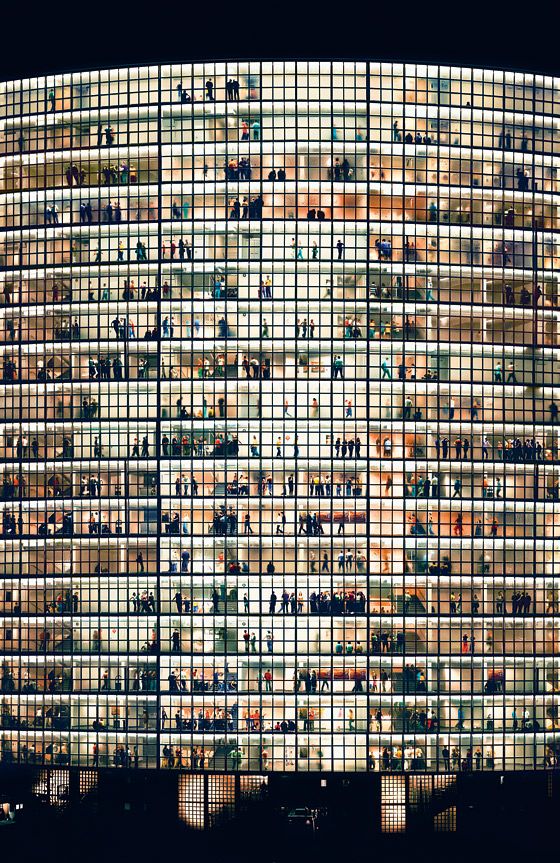
Bildbeschreibung Andreas Gursky, May Day V, 2006

This development has by now arrived even in consumer photography. As the well-known tech blogger Marques Brownlee explains in his video “Why New Smartphone Cameras Feel Worse” (published on YouTube on 11 May 2026) a wide variety of algorithmic image-processing operations running in the background have long since penetrated general consumer photography. These operations range from multi-frame stacking to semantic segmentation, which treats faces, skies, and foliage as separately optimizable objects.

Marques Brownlee, Why New Smartphone Cameras Feel Worse, 2026

What Brownlee laments in his video about the new, hyper-processed image aesthetic of contemporary smartphone photography is the complete leveling of all structures of image organization. Nothing in these images remains in shadow any more – everything is pushed, as it were, side by side into the foreground. This produces an image aesthetic of Gurskyesque radiant artificiality. One could claim in this context that the algorithmic processes inscribed in modern smartphone cameras condense, in Gursky-like fashion, the image material produced by users through technical interventions. What these cameras generate, then, is an aesthetic that is no longer showing anything specific. Baudrillard, one might claim here, has become pop culture at least today.

The phenomena described are more or less widely discussed – I am primarily tracing a line of discourse here. At present, however, a further step is beginning to announce itself, or so I want to claim: the processes described are being radicalized once more through recourse to AI technologies. What I want to bring into view in what follows, then, is a further detachment from the concept of an objectively comprehensible world, which is presently being played out to the full by artists. And I would claim that this development is already graspable as an upcoming dynamic in the broader consumer culture.

Artistic detachment Even if it remains fundamental to this day that information-based images allow unlimited interventions in their data structure and thus also in their visible surfaces, reception has for the most part remained confined to images and image perspectives that “simulate” objectivity. It is this claim of simulation itself, I want to argue, that is now being called into question by technically engaged contemporary artists. The difference is decisive: Photoshop intervened in images that continued to look like central-perspectival world; its manipulations were directed at surfaces that upheld the claim of depicting something. The phenomena discussed below abandon this claim itself – they no longer simulate a view onto the world but exhibit the technical conditions of image production itself. I will call these phenomena in what follows image machines.

Crucial for my argumentation are two contemporary artists, Anton Elfilter and Karlo Lovrenščak aka Mezotes, whose positions I read as exemplary of this shift. Both artists work extensively with AI technologies and, with the help of these current technologies, detach themselves ever further from the appearance of an objective reality. Both artists – and I consider it particularly important to emphasize this – no longer produce (simulated) depictions of existing or fantastic realities. One could say: if every computationally produced image today is latently an image machine, these two artists make that latency explicit – they exhibit the machine in the image. Elfilter and Lovrenščak thus work, as I want to show, against the cultural-historical “weight” of central perspective. They dissolve systems of reference that have accompanied us for hundreds of years and have shaped the way we deal with the world. The works discussed below were published by both artists on their Instagram accounts in 2026 and are cited here from that context.

Anton Elfilter’s AI compositions show beautifully what happens when the image composition itself is broken down into dynamic clusters, with even text, and traces of code being adopted as image values.

Elfilter, Video 1: Anton Elfilter, elfiltera-Dasq8eRDEnj, 2026. Published on Instagram https://www.instagram.com/elfiltera/, accessed 17 July 2026

In this composition, overlapping lines of movement are brought together in a single image space. It is this contradictory unity that also characterizes most of the compositions described in what follows. Here, vertical depictions of, for example, classical trains running on rails, together with textual elements likewise running vertically across the screen, are contextualized by landscape depictions that unfold mostly horizontally. The composition is thus marked by image elements moving in different directions at different speeds. One could speak of a “Wimmelbild” – a teeming picture – were this not so evidently clearly organized.

Elfilter, Video 2: Anton Elfilter, elfiltera-Dasq-LmjFY2, 2026. Published on Instagram https://www.instagram.com/elfiltera/, accessed 17 July 2026

The second composition superficially stabilizes our visual access with larger visual elements. Within it, however, the dynamics of movement are heightened by faster-running image elements. What is intriguing here, too, is that the apparently condensed depictions of nature are now overlaid with a more considerable number of textual lines of movement. Nature sceneries, presumably extracted from postcards, thus unfold here in superimposition with recordings of displays and the text running across them. As if on conveyor belts, images are fed to us here in horizontal bands and counterpointed with technical recordings. This is the composition’s distinct argument: everything about it reveals itself as image machine, while the content defined by a postcard idyll recedes into mere material.

Elfilter, Video 3: Anton Elfilter, elfiltera-DavV1majOTU, 2026. Published on Instagram https://www.instagram.com/elfiltera/, accessed 17 July 2026

This third composition presents forms that constantly re-fragment themselves, not only at different speeds but also in their directions of movement. Images of flowers do not merely run abstractly across the display here – in the lower right third, they are even splintered into abstract forms. An inkling arises here of the aesthetic qualities the flower templates once originally possessed. The image space thereby takes on something lovely and yet keeps tipping, again and again, into the abstract visuality of geometrically fanned-out display surfaces. Here, too, the perspectival order is absent. Everything dissolves in technological dynamics, remains legible only in references. The technical mediality of the image is thus pushed, almost forcibly, into the foreground. This image machine brings the appearance of classical beauty into view, only to let it founder in the dynamic image clusters of a composition.

Elfilter, one could superficially claim, is working through the potential artificiality of AI-generated images. Such a claim, however, would not rate highly enough the deliberate dynamization of the image surface, the artist’s evident will to form. These compositions peel out the digital information space and its aesthetic potentials, unbounded by AI technologies, beyond and against the visual codes of (simulated) central-perspectival assertions of the world. What is important here is that these are evidently not glitches, not deliberately addressed errors, but consciously assembled compositions that assert an aesthetic autonomy of their own. What is being worked on here are image machines that set themselves apart from historical assertions of the world. They do so by pushing the technical layers of the visible into the image until these layers become more dominant than what is depicted.

Karlo Lovrenščak aka Mezotes works in a comparable, yet more theatrically staged, manner than Elfilter. In his work too, dynamic, moving image axes are superimposed. Lovrenščak also works, as I want to suggest, on image machines that make their own artificiality their theme. The artist, however, thinks more sculpturally than Elfilter. He stages the seeming artificiality of his images not primarily in superimpositions but as a total ensemble unfolding, as it were, sculpturally. This becomes apparent when one considers the following composition.

Mezotes, Video 1: Karlo Lovrenščak aka Mezotes, mezotes-DW6b1TciLf7, 2026. Published on Instagram https://www.instagram.com/mezotes/, accessed 17 July 2026

Here, too, bands of images run toward us. The axes of movement, however, are defined here image-immanently. They are organized within an overall composition, which becomes especially clear at the very centre of the image, where the depictions running toward one another almost begin to strike sparks. The textually and visually determined image space is thus posited here as something that seeks less to play across the image surface than to fill it with a form. The artist’s will to design thus becomes even more clearly legible here than it was the case with Elfilter. Here, radicalized as against the position defined above, the following holds: this image machine brings into view only the appearance of naturalness of the source material in order finally to let it be absorbed into a dynamic image clusters.

Mezotes, Video 2: Karlo Lovrenščak aka Mezotes, mezotes-DYPWtgfjQev, 2026. Published on Instagram https://www.instagram.com/mezotes/, accessed 17 July 2026

In the second composition I cite here, too, the artist points beyond the image space – or rather intervenes sculpturally within it. At the centre, a person remains visible, directly addressing the beholder. The image frame, or background, however, is dissolved into rasters at times reminiscent of data grids, only to tip later into an image space resembling rock faces. Traces of code and data grids, it can be claimed, are in this composition transferred (in a visually graspable way) into objective surface structures. Digital image space and simulated depictions of analogue patterns blur here into an encompassing image narrative. Code becomes a waterfall – the image unfolds from aesthetic ciphers of digital image aesthetics toward an analogically legible image spatiality. And with the yellow tinsel, he lets rain down in the course of the piece, the artist himself parodies this very transformation. The image machine staged here shows its own mode of functioning, and shows how it unfolds pictorial depth out of technical processes. Here, too, the formula defined above holds: the technical layers of the visible dominate what they depict.

Mezotes, Video 3: Karlo Lovrenščak aka Mezotes, mezotes-DYPWtgfDQTR, 2026. Published on Instagram https://www.instagram.com/mezotes/, accessed 17 July 2026

In his third composition included here, Lovrenščak once again focuses on a digital “hinge” staged sculpturally within the image. Between landscape and sky, a digital image cluster rotates upward, letting images showing mountain landscapes from above spin ever further into themselves. This image spiral seems to screw itself into the vault of the sky – which in turn seems almost to bulge outward to absorb the spiral into itself. What this description alone shows well: nothing about this depiction is legible as natural anymore. In the ensemble, the machinic itself is moved to the centre. It is made legible. Lovrenščak, it can thus be claimed, generates narratives utilizing his image machines. He makes technical positions of mediation visible. In his abstract, almost sculptural ensembles he makes clear that artificiality and naturalness have long ceased to be categories interesting to him. What is interrogated instead are the modes of functioning of technologies such as AI and the aesthetic possibilities that result from them.

The cultural-historical “weight” of the central perspective, which I made a strong case for at the outset of this essay, plays no central role for Lovrenščak and Elfilter anymore. Their image worlds rotate within themselves and within the narratives they shape. The function of reference to an outside is itself regarded as so superfluous here that it remains legible at most as a secondary reference to the modes of functioning of technologies. Aesthetically and visually, then, image models are being developed here for a present that no longer regards even simulations of the real as central. This is where the present moves beyond Baudrillard: his simulacra still lived off the reference to a real they displaced; the image machines described here no longer even raise that claim. And this rupture, I want to argue, can be understood as a kind of artistic analysis of the present. The precedent is instructive: Gursky’s aesthetic of total visibility took barely two decades to migrate into the processing pipelines of smartphone cameras. It remains to be seen, accordingly, when and in what way this analysis will also represent itself in the algorithms relevant to consumer electronics. Hence, one can claim: The world, as it emerged from the perspective of an idealized, posited gaze has lost its relevance according to the artists cited here. The rule is abandoned, and the artists turn to new AI players, allowing them to re-define the depictions of reality itself.

Résumé The world as it emerged from the perspective of an idealized, posited gaze has, according to the artists cited in this essay, lost its status as law. What remains for them of central perspective and its layered order is citation material. From this observation, a thesis can be derived: the image machines of Anton Elfilter and Karlo Lovrenščak aka Mezotes do not simply add another chapter to the history of digital image manipulation – they mark the point at which images cease to assert the world at all. Where the camera obscura promised objectivity, and where Photoshop and smartphone algorithms still simulated it, these AI-based compositions push the technical layers of the visible into the image as more dominant than anything they depict. The reference to an outside becomes secondary; the machine itself becomes the subject. If the central perspective once made the world describable as image, the image machines of the present make images describable as machines. And it is precisely this reversal, I want to claim, that constitutes a valuable artistic analysis of our present.

AI stands at the centre of most Western debates about the future of work and the organisation of our societies. And with striking regularity, these debates collapse into a single spectacular question: will artificial intelligence one day conquer and enslave humanity? This framing is, notably, promoted most energetically by the AI industry itself. The same companies that publicly warn of existential risk—and call for rules to contain it—are simultaneously racing to build precisely the systems they claim to fear. This is not a contradiction; it is a strategy. The apocalyptic scenario functions as a marketing instrument and, more importantly, as a screen. It displaces the questions that actually matter, like: What is happening in the societal reorganisation of our (work-)societies under the AI boom? Who profits from this reorganisation? And why should we be obliged to accept technologies built on the dispossession of the masses—on the extraction of the value of their professional and creative expression and on the quiet erosion of their legal capacities within contemporary data spheres? What is rather at stake here, as I want to discuss in the following, are the epistemic infrastructures through which we perceive, filter, and process the world— infrastructures that predate the AI boom. The danger, in short, is not a predatory technology. What has to be criticised, consequently, is the displacement of attention itself: away from the question of real-world operative controls toward speculation and suggestion.

A counterpoint helps to situate this claim. It is worth testing visions of an upcoming singularity against a context in which software cannot afford to be projection: the battlefield. The Ukrainian battle management software Delta offers a uniquely instructive case because it was conceived and implemented under the threat of military annihilation. Military technology certainly offers no examples of systems promoting emancipation or equality—but it enables something else: a reflexive “stress test.” In war, every fault and every delay has lethal consequences, above all when the opponent commands vastly greater resources. How software is built and used under these conditions can therefore serve as an index of what efficient, genuinely operational software design looks like, stripped of marketing claims. This is not to declare a targeting system a model for society; it is to use the harshest available testing ground as an analytical instrument.

This argument requires caution. European armies have not been technological innovation hubs in recent decades; they are bureaucratic apparatuses that tend to suppress dynamic development rather than enable it. For example, David Graeber, in Bullshit Jobs, recounts the case of a subcontractor for the German Bundeswehr whose entire job consisted of driving for hours between barracks to perform trivial IT tasks—in the most absurd instance, moving a computer a few metres down a hallway, a procedure requiring forms, approvals, and a paid external specialist for something a soldier could have done in five minutes. The anecdote is exemplary rather than exceptional: contemporary armies are bureaucratic conglomerates, structurally inefficient and nearly impossible to navigate. The recent implosion of the Franco-German FCAS fighter jet project, which included, tellingly, the development of a cloud-based combat software layer, is a symptom of the same institutional paralysis.

The relevant management software suites have instead been developed in the private sector. Salesforce is the canonical case, signaling already in its name that it conceives the entire complex of corporate activity as a kind of battlefield. Its declared aim is to automate sales, service, and marketing through humans and AI agents cooperating on a single platform—the amplification of productivity through better-organised knowledge and exchange among all actors in a work process. Structurally, this is the exact counter-model to the Bundeswehr: where the bureaucratic apparatus fragments information and immobilises its members, the platform connects actors and accelerates their shared processes. Software like Salesforce thus demonstrates the organisational capacities of the platform form—while still leaving open whose interests these capacities ultimately serve. A good battlefield control and logistics software does precisely what the platform form promises, applied to the information-saturated battlefield. Network-centric warfare—the bleeding edge of contemporary military doctrine—is, at its core, nothing other than this platform logic translated into the military domain: it builds on software like Salesforce. That no “Bundeswehr Salesforce” exists to this day demonstrates how deeply most armies remain caught in pre-digital organisational mentalities.

Battle Management Software Ukraine cannot afford this luxury. Since 2014, and with existential intensity since February 2022, the country has been forced to build military capability under conditions in which inefficiency is not an administrative nuisance but a mortal threat. The result is instructive: an entire software ecosystem that emerged not from institutional design but from necessity. The origins of this ecosystem, traced in detail in the study Mapping the MilTech War by Kostiuk, Patiuk, Sapochkina and Tenenbaum, lie in a volunteer-driven response to the annexation of Crimea in 2014. Responding to this invasion, an NGO named Aerorozvidka evolved into a hybrid military-civilian innovation hub, building early situational awareness tools on civilian hardware—smartphones, tablets, and commercial drones—guided by speed, accessibility, and decentralised input rather than doctrine. These experiments laid the foundation for Delta, which emerged in 2017 as a digital mapping and coordination tool: cloud-based, fed by frontline input, and shaped by rapid feedback loops between operators and developers. Delta was not born of the military-industrial complex; it was born of its absence.

The full-scale invasion of February 2022 transformed Delta, as the study further highlights, from a niche innovation into a national situational awareness infrastructure. Russian strikes on fixed command posts forced Ukraine toward distributed command and control, and Delta provided the shared digital common operating picture this demanded—even if adoption initially remained uneven and interoperability gaps produced characteristic workarounds.

The qualitative shift came, following the authors, in 2023, when the Ukrainian Ministry of Defence formally authorised the system: Delta ceased to be a map and became an information management platform aligned with NATO data standards, onto which other tools—ISR feeds, drone coordination modules, and encrypted messaging—were docked as modules. By 2024–25, it had become an AI-enhanced, platformised ecosystem managing the extreme data density of a drone- and sensor-saturated battlefield, with a surrounding weapons software family—Kropyva for artillery fire control, Armor for armored unit coordination (cutting coordination latency from over twenty-five minutes to under seven), and Vezha for UAV streaming and post-strike assessment—feeding its data back into Delta dashboards.

What this architecture makes visible is a shift in the very meaning of situational awareness—the conceptual core of network-centric warfare. Ukraine processes tens of terabytes of ISR data daily—drone video, satellite imagery, acoustic sensors, and textual reports. The challenge for the Ukrainian army is no longer perception but cognition: not seeing the battlefield, but managing information flows and the cognitive load they generate. Delta's function is to filter, prioritise, and contextualize—to operate as an epistemic infrastructure for a conflict whose tempo and data volume have outpaced unaided human processing capacity.

And here lies the decisive finding. Within this forcibly accelerated development, AI was integrated strictly as a supportive layer—even if Ukrainians have access to the most advanced LLMs available. The Ukrainian experience, which was documented in detail in Mapping the MilTech War, shows that AI is most effective when it speeds up analysis and coordination, not when it replaces human decision-making. Practical gains, as one can claim against this background, come from embedding AI into existing systems to reduce workload and reaction time, not from pursuing full autonomy. Communication constraints and battlefield unpredictability mean that small-scale human-machine teaming consistently outperforms visions of autonomous swarms. What no language model provides is the specifically human capacity to improvise under pressure, to read terrain and intention, to stitch together centuries of accumulated tool use—maps, protocols, intuitions—into decisions under conditions that exceed any training. The human spark still is central to the operational processes connected to Delta. On the densest battlefield in the world, the system is built to enable humans to decide better, not to decide for them. And this design decision obviously builds on experience. Where survival is at stake, no one sane bets on the marketing claim of machine superiority.

Negotiating Epistemic Infrastructures The Ukrainian case, read carefully, further yields not a technological lesson but a political one. Delta became so powerful because of a specific social configuration: developers and users were largely the same people, or at least shared the same risks; feedback loops between operational reality and software design were direct and fast; and the system's purpose—enabling its users to survive and decide—was never in conflict with the interests of its former NGO makers. The software serves those who use it because it was built by and with them.

This is precisely the configuration that the dominant AI economy inverts—and inverts strategically, through its vision of full automation. Here the comparison with Salesforce also reveals its limits: the platform form itself is neither emancipatory nor predatory; what decides its character is the relation between users and owners. The systems currently reshaping our work, our attention, and our public spheres are designed by private actors, optimised for the same actors (commercial) interests, and deployed onto populations who have no say in their architecture, their training data, or their purposes. The alignment between user and owner that makes Delta effective is structurally absent here—and the gap between the two is precisely where dispossession occurs.

The central argument advanced to legitimise this strategy is that the machine is—or at least soon will be—more capable than human beings. Measured against the most demanding real-world deployment available, this claim has so far not held and will most likely not hold. What the promise of superior machine capability actually accomplishes is to justify removing humans from the loop—not because the technology demands it, but because ownership interests do. The way platforms like X and TikTok are deployed today to generate political dynamics benefitting above all specific actors and political movements illustrates the same logic at the level of public discourse: this is not an accident or a malfunction; it is what a technological infrastructure does when its purposes are set by oligarchs rather than negotiated with its users.

Against this background, the function of the general-AI debate becomes legible. The scarecrow of superintelligence is not a warning but a misdirection: it relocates the political question into a hypothetical future—promised as glorious, feared as destructive—where it disappears behind the spectre of a coming superior entity. The Ukrainian battlefield actually does not settle the question of what machines might one day be capable of, but it already suggests that these capabilities will likely look very different from the fantasies currently circulating in Silicon Valley. And it shows with unusual clarity where the actual value of AI lies today: in augmenting human judgment, not replacing it. Hence, it is precisely this displacement of attention—away from the politics of present infrastructures and toward speculative futures—that constitutes a political move that has to be criticised. The real question is not whether machines will eventually overpower human judgment. The real question is who controls and will control the increasingly AI-driven epistemic infrastructures that frame our perception—and according to whose interests they filter, prioritise, and contextualise our world. The answer decides nothing less than whether these infrastructures will work for the 99% of humanity or merely on them.

What is needed, therefore, is not a moratorium on imagined futures but a democratic negotiation of the infrastructures of the present: how LLMs are trained, what they are optimised for, to whom they are accountable, and how the people whose cognition they shape gain a voice in their design. The relevant infrastructures were not born with the AI boom—they have been layered over decades; AI is merely their newest sediment. Delta demonstrates that software built under real pressure, with real stakes, and with the genuine participation of its users converges on augmentation rather than replacement—on serving human judgment rather than supplanting it. The distance between that model and the one currently governing the AI economy is the precise measure of what remains to be dealt with. Or, to put it more bluntly, there is no need to fight against current (AI) technology, but there is a dire need to fight over it.

When surveying popular culture over the past few decades, the comic genre — though few are aware of it — can be described as a kind of “meta-genre”: a form that not only produces its own stories, but continuously feeds and shapes other media. Major blockbusters of the film industry, to name only X-Men or the Avengers, were built on comic source material. And the fundamental visual style of emerging AI-generated video appears equally indebted to the hard context cuts that define the comic form. What makes the comic genre particularly significant, however, is not merely its influence on other media, but its capacity — especially in its more ambitious iterations — to sustain complex analytical narratives over years, in ways that film or television rarely permit.

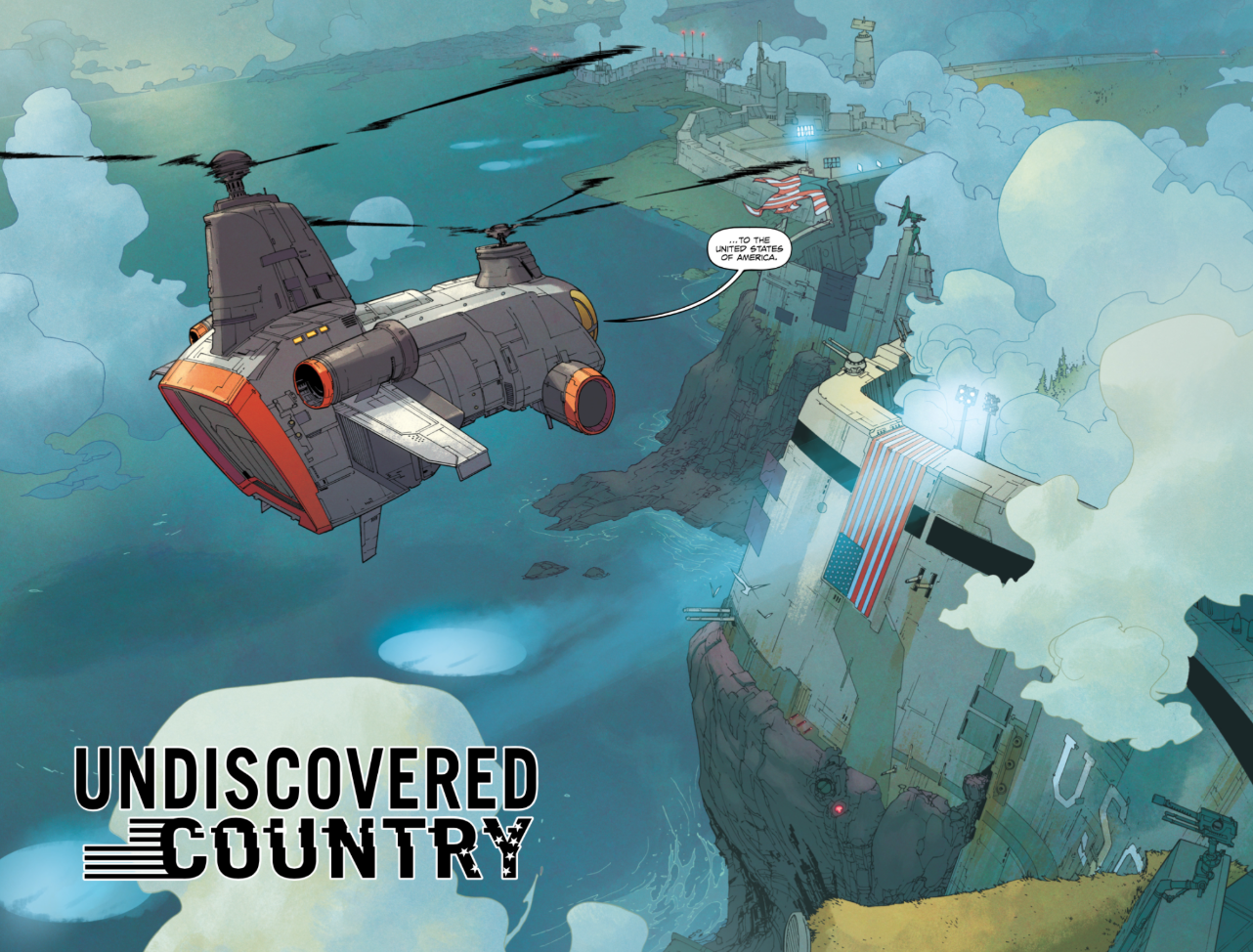
In parallel, a scene has established itself in the United States over recent decades — centered around the publisher Image Comics — focused on authorship and on creative approaches to the genre. In this environment one finds not only continued radical approaches to science fiction, approaches long since lost to popular cinema. One finds equally incisive analyses of our present: critiques not only of gender roles and racism, but also of dominant narratives, of our access to concepts such as community, statehood, and identity — in a manner that seems no longer possible in other genres. It is precisely this sustained analytical capacity of the comic form that makes Undiscovered Country so remarkable a case.

The comic series Undiscovered Country by Scott Snyder and Charles Soule, which stands at the center of this essay, was able to develop its themes over seven years (2019–2026) — an enormous span of time by the standards of contemporary popular culture. And it is this influential series that has found its conclusion in recent weeks. At the center of the series stands, as the title already suggests, the search for the identity of a country — in this case the USA. What can be said against the backdrop of the series' final issue is this: its analysis of what the USA is, at a time when its inner compass has been radically reoriented, represents a statement of central value for understanding our present time.

In what follows, I plan to take a brief look at the series — one that can in no way do justice to its aesthetic and artistic value — and to place its engagement with the present at the fore. I plan to show how the series develops conclusions that help us better understand the developments of our time. Against this backdrop, a spoiler warning must also be issued here. The series will be approached without regard for preserving the reading pleasure and suspense of the final ending for potentially interested readers. I ask comic enthusiasts to forgive my reading and mode of analysis.

Bildbeschreibung

“Journey into the near future, and an unknown nation that was once the United States of America — a land that's become shrouded in mystery after walling itself off from the rest of the world without explanation over thirty years ago.” This is the basic introduction to be found on the official website of Image Comics for Undiscovered Country. The storyline places us in the near future, in which the USA has decided to seal itself completely from the rest of the world. We are introduced to a time in which a global pandemic has devastated civilization and new superpowers and alliances are competing for dominance. At precisely this moment — thirty years after the complete withdrawal of the USA — a message reaches the outside world. A cure for the pandemic may be available within the United States, and new trade agreements might be possible. Against this backdrop, an expedition is assembled to visit the now unknown United States. The storyline begins with the introduction of seven persons brought together for this expedition and accompanies them on their journey through a land that was once known as the United States of America.

Bildbeschreibung

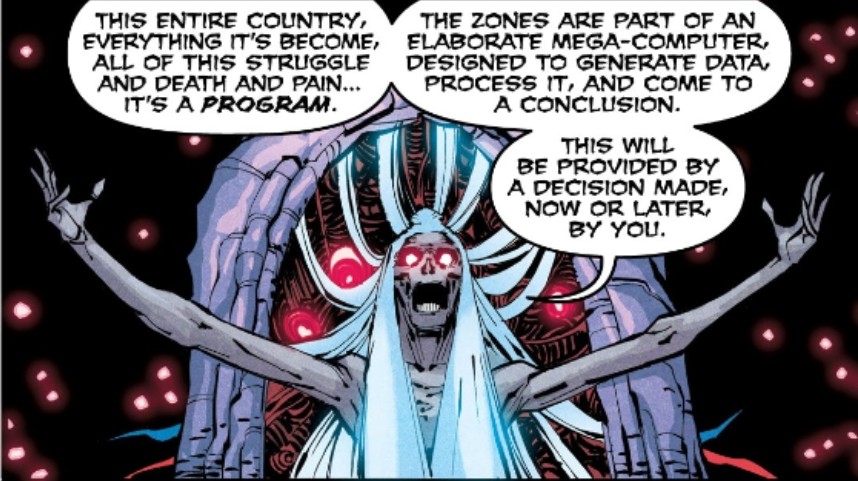
Across a total of thirty-six issues, this expedition group is accompanied through the USA. What the group quickly learns is that the USA has been internally transformed into a series of zones — seven in total, each governed by a dominant idea in American culture. Of these, two are particularly central to the series' analytical ambitions and will be examined here in greater detail. “Unity” pursues the vision of digital technology to its radical conclusion. “Destiny” — closer to the Wild West — is a place in which the personal pursuit of happiness, freedom, and self-invention is practiced with terrifying consistency and violence. What distinguishes all the zones of the new America is a rupture between a fascinating surface and a deep corruption that has taken hold within. On the journey we learn ever more about the ideologies that determine the new America and the deep fractures and abysses that manifest within them. Along this path we further learn that the USA has long been taken over by a supercomputer called “Aurora” — not merely a backdrop, but the story's central dramatic force, orchestrating the entire journey from behind the scenes.

The adversaries the group encounters are drawn as extreme caricatures. A full account of the series' characters lies beyond the scope of this essay. Two, however, demand closer attention. The “Destiny Man” accompanies us through various narrative turns until the very end of the storyline. He is a figure of radical self-transformation and capacity for violence, a hunter who in the course of the story increasingly begins to determine the fate of the expedition group.

Bildbeschreibung

Equally characteristic for the course of the story is the mistress of the “Unity” zone, Dr. Naira Jain, who initially greets the visitors with warm hospitality.

Bildbeschreibung

As with practically every first encounter in the zones, Jain appears at the outset almost clichéd in her friendliness. She presents the achievements of her zone in convincing terms. The storyline in Unity, too, unfolds as a slow and steady demystification — the unmasking of a toxic narrative. At the end of the journey through Unity we must learn that the glittering digital surfaces were mere appearances. Beneath them, nothing but bare violence against children and bodies is to be found. It is also from Jain that we learn the true character of the new America. The country has been transformed, as she explains, into a gigantic computer designed to process all local knowledge in order to enable global insights into the nature of existence.

Bildbeschreibung

As the story progresses, it becomes ever clearer that it is the expedition group whose insights Aurora has been waiting for all along. Their accumulated understanding, gained through the journey across the different zones, is meant to provide Aurora with the final impetus to answer the question of what America actually is — what this country, this idea, is defined by at its core. It is at this point that Aurora steps fully into the foreground: no longer a system governing from a distance, but an active interlocutor demanding an answer.

And here we arrive at the analytical core of this story. The zones themselves are not merely plot devices; they are arguments. Each one stages a dominant strand of American self-understanding and exposes its internal contradictions. At all the exaggeration of its characters, the series commits to a critical analysis of what constitutes contemporary America. Dominant narratives are unfolded and the underlying horrors exposed. Against the backdrop of current political and cultural developments in the United States, lines of discourse are traced here that help us understand what we are dealing with: a country that has, in essence, set out searching for its identity.

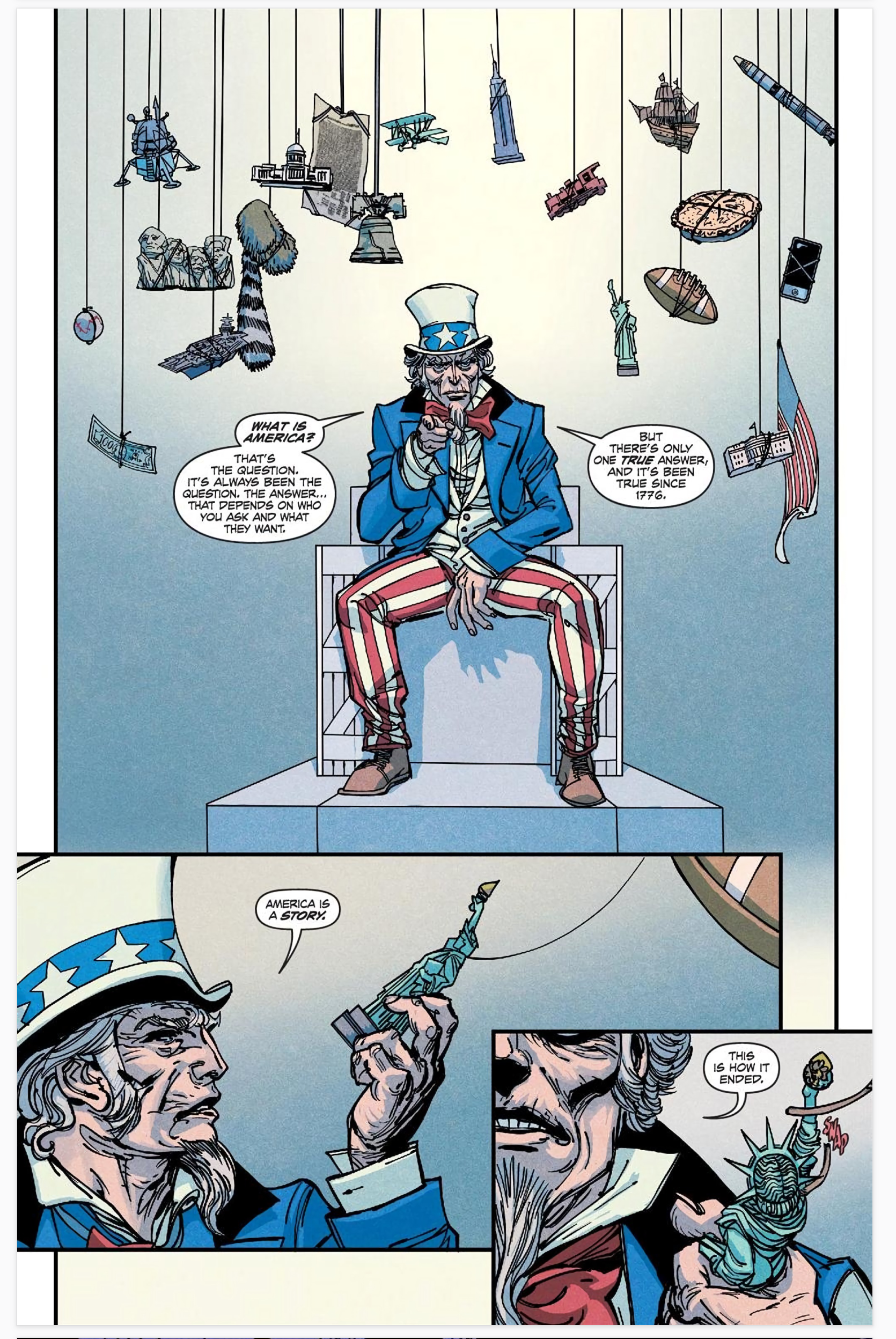
The comic expedition's search leads finally to the moon, to which Aurora, as we learn, has retreated. The location of the moon serves not only as a reference to one of the greatest achievements of American history — the first moon landing. It also symbolizes the existential distance that Aurora's technical presence has taken from its actual subject: the United States of America. On the moon we encounter the supercomputer in various guises. It speaks of the end of America's narrative and asks simultaneously how that narrative might be continued.

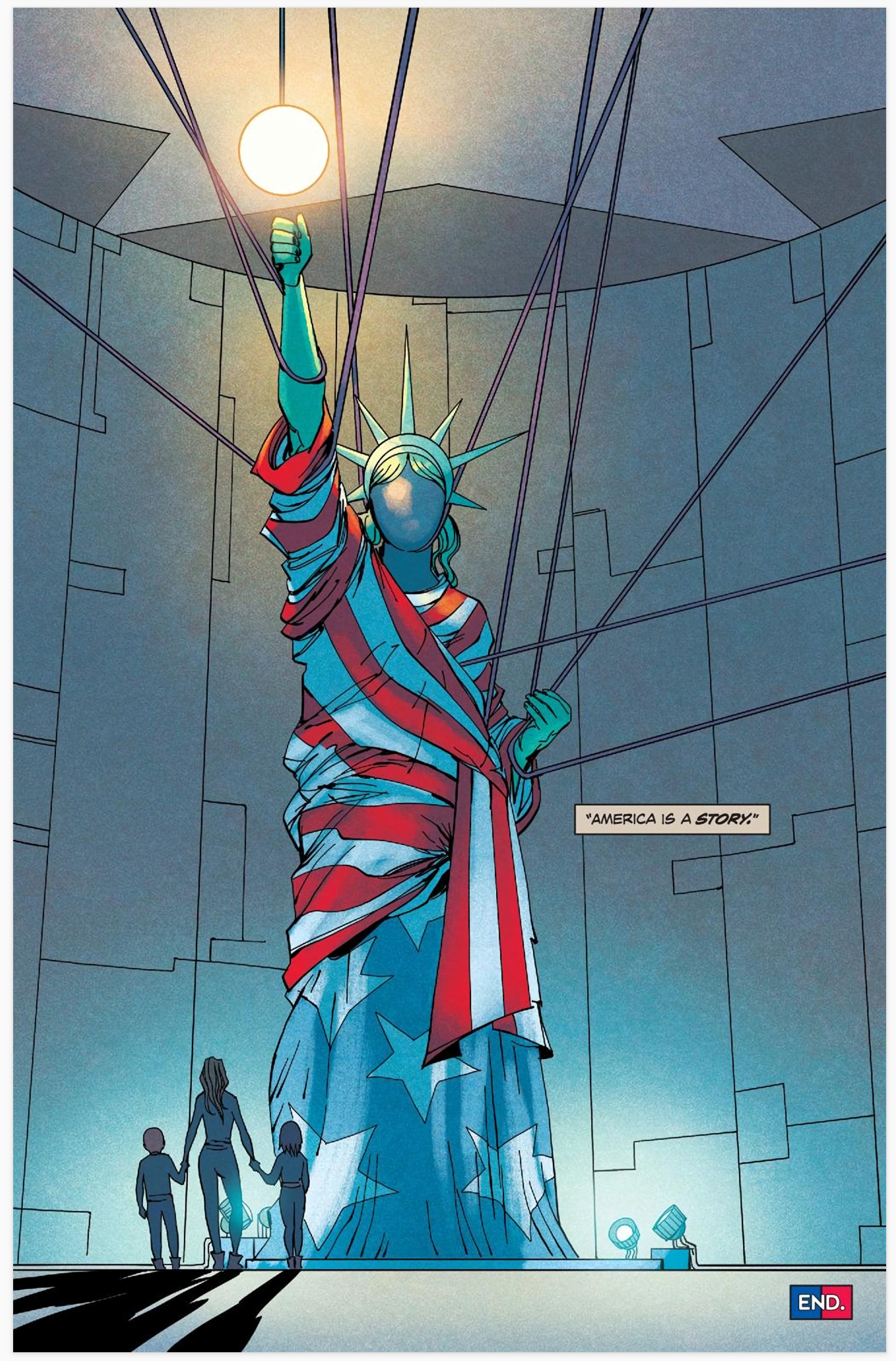
Aurora's visual representations shift from exaggerated depictions of historical figures —

Bildbeschreibung

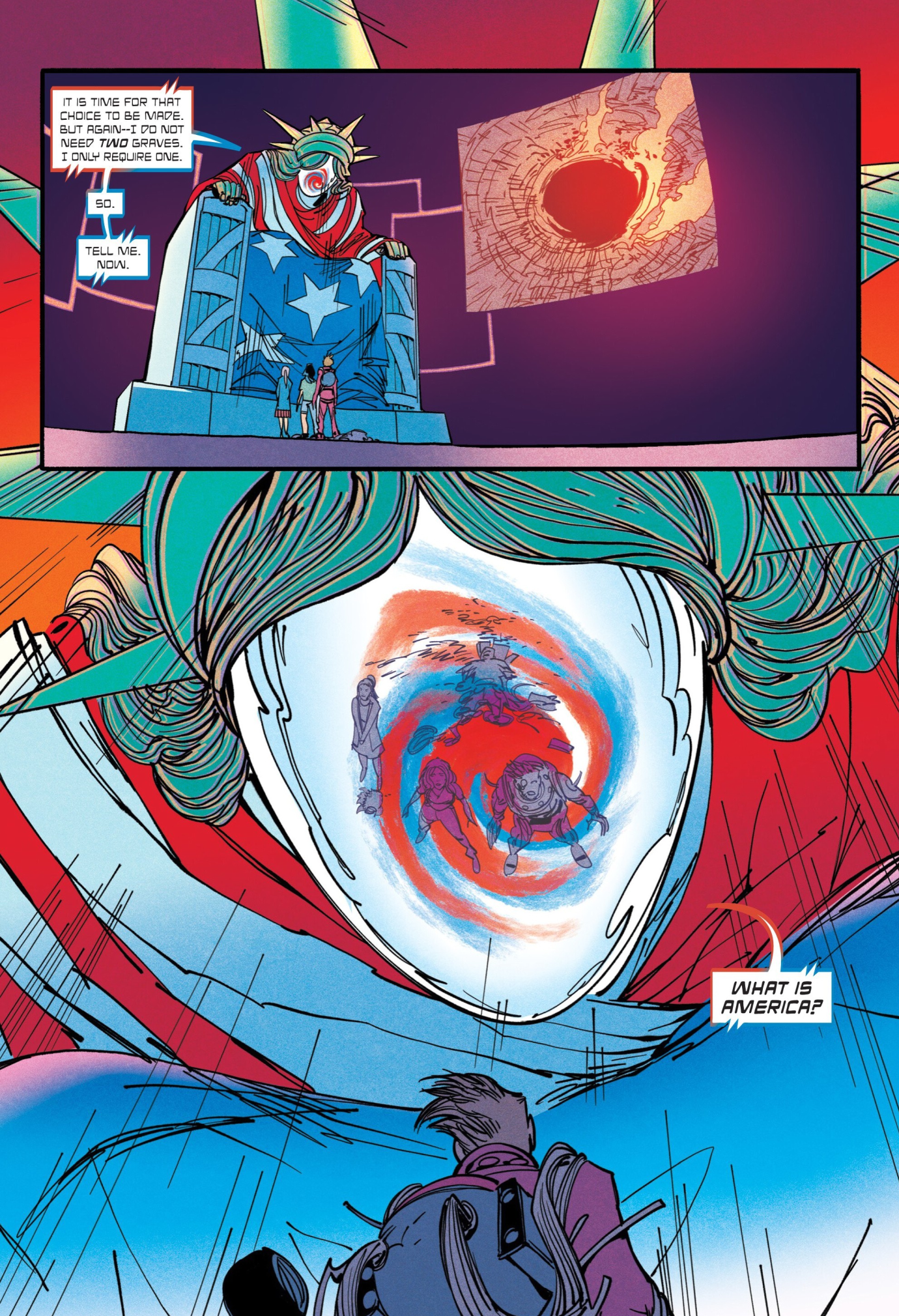
— to technically bastardized adaptations of the Statue of Liberty: a robotic entity in the body of the statue, formulating its central question with forceful insistence.

Bildbeschreibung

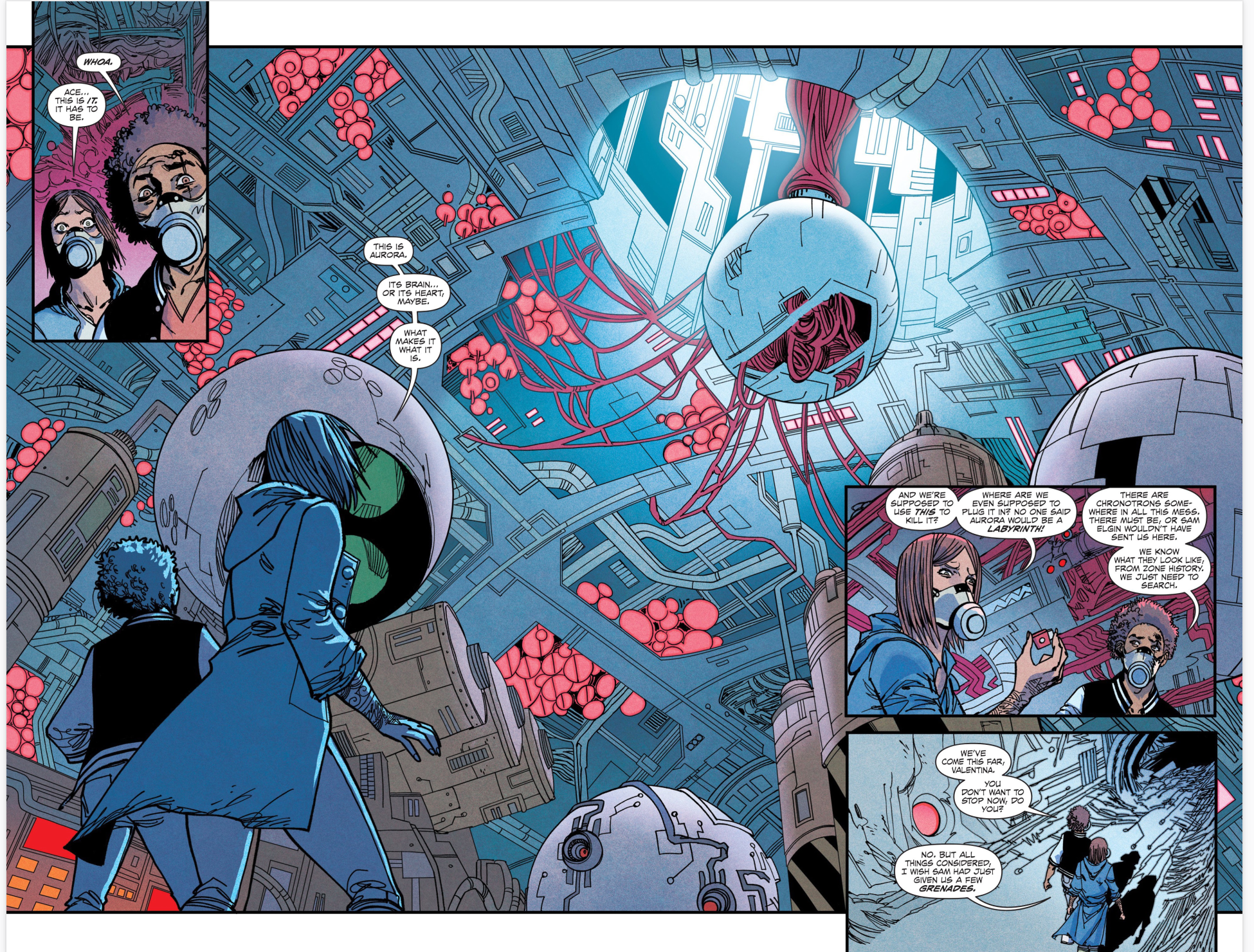
Over the answer of the expedition group — and over the question of who among them is entitled to give it — a struggle breaks out in the final section. It arrives at no conclusion capable of satisfying us. The Destiny Man, now transformed into a human body, declares that conquest and the projection of power stand at the center of America's identity. That this answer does not lead to catastrophe is due solely to the fact that two members of the expedition have, over the course of the journey, gradually learned to develop their own narratives of love and care — one might speak here of counter-narratives. Among them is the group's journalist, whose role throughout has changed from observation to poetic action. It is they who, having learned to tell a different kind of story, ultimately penetrate Aurora's engine room and sever all lines of connection and control running toward Earth.

Bildbeschreibung

Isolated on its lunar machinery, Aurora finally recognizes that it can no longer fulfill its mandate to redefine America and shuts itself down. The potential catastrophe is averted. The present is once again transformed into a space for the inhabitants of America themselves to shape.

The statement that can — and must — be read from Undiscovered Country is unambiguous. The question of whether America's narrative is a toxically dangerous one for humanity is marked as secondary. Where the danger lies — and this thread runs through every issue — is in the smooth surfaces, in technological visions that claim universal validity. So long as it is technology that defines which narrative about the United States prevails, we remain in danger of a violently inhuman reorganization of our present. It is individuals who regain control over their own narratives — who refuse the stories handed to them and develop, together, something harder to systematize: stories of love, of care, of mutual responsibility. It is precisely they who prove capable of penetrating the engine room of violence and preventing catastrophe. The series is insistent on this point: collective stories of love and care are not a soft alternative to emancipatory action. They are emancipatory action.

The question that technology poses to us is identified in Undiscovered Country as a question about the great whole — about what we are, what we want, and what kind of world we are prepared to inhabit together. And more important still: it is not the answer that prepares the way toward emancipation, but the recovery of our capacity to ask — for ourselves, without intermediary. The series suggests, quietly but insistently, that any system which takes that capacity from us is a form of dispossession. The series' engagement with the present can thus be read as an urgent call for human self-interrogation and self-emancipation. America's tragedy is located, at its core, in having submitted to a technical redefinition — and in the failure to meet that redefinition with a living counter-narrative of its own. At a time when AI systems and algorithmic infrastructures not only filter information but increasingly set the very conditions under which political identities come into being at all, this is more than a literary motif. It is a diagnosis.

Bildbeschreibung

The collective Clusterduck in Zurich

Art in public space has always faced the challenge of having to constantly reinvent itself. Yet in the digital age, this challenge is more pressing than ever: how can art be defined when public space itself becomes a hybrid entanglement of physical locations, digital networks, and algorithmic logics?

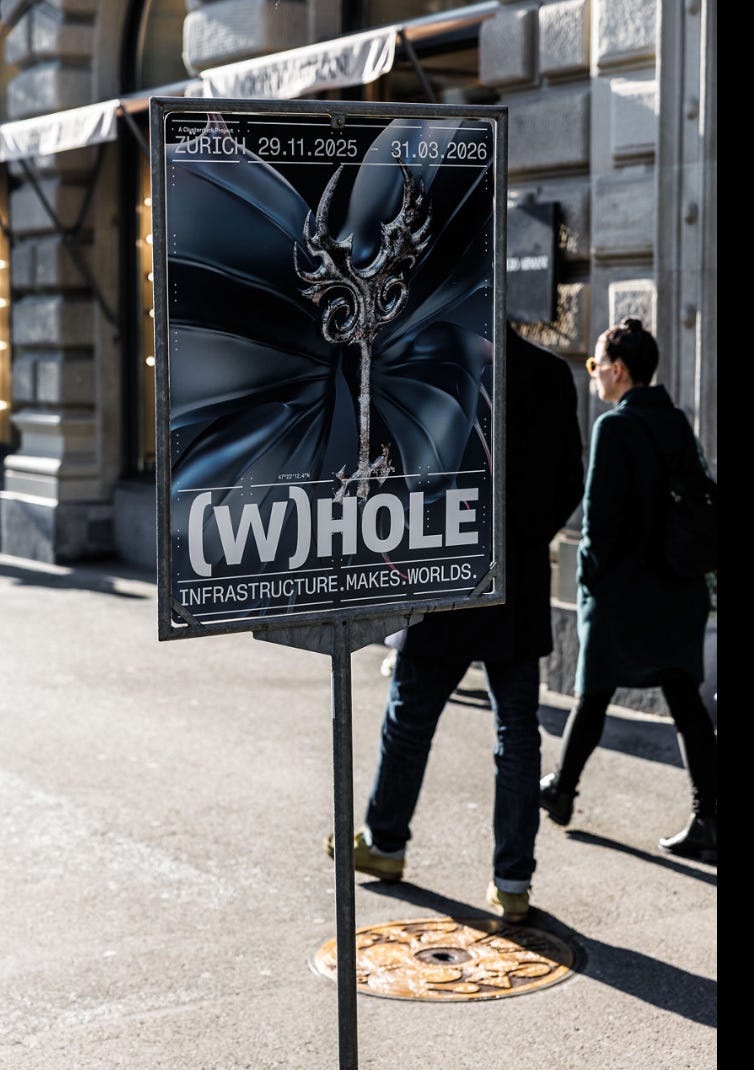
It is precisely against this backdrop that the artist collective Clusterduck currently positions itself with their project The (W)hole, on view in Zurich. In their exhibition project, Clusterduck addresses the omnipresent yet elusive presence of technical structures. They translate these into installations and scenarios that can be experienced in urban space. And to do justice to the technological complexities of our contemporary lifeworld, The (W)hole presents itself not as a clearly delineated sculpture, but as a complex, multilayered ensemble.

Bildbeschreibung

The starting point for Clusterduck is the concept of the “Stack” developed by theorist Benjamin Bratton. Bratton understands the “infrastructure” surrounding us — shaped by digital technologies — as a complex arrangement divisible into six layers. The layers Earth, Cloud, City, Address, Interface, and User each represent specific functional structures. They refer to elements that we can sometimes personally appropriate and survey — such as the city — as well as those that fundamentally elude our grasp, such as the Cloud. Clusterduck thus adopts the concept of the Stack to point to the comprehensive expansion of our lived realities through contemporary digital technologies.

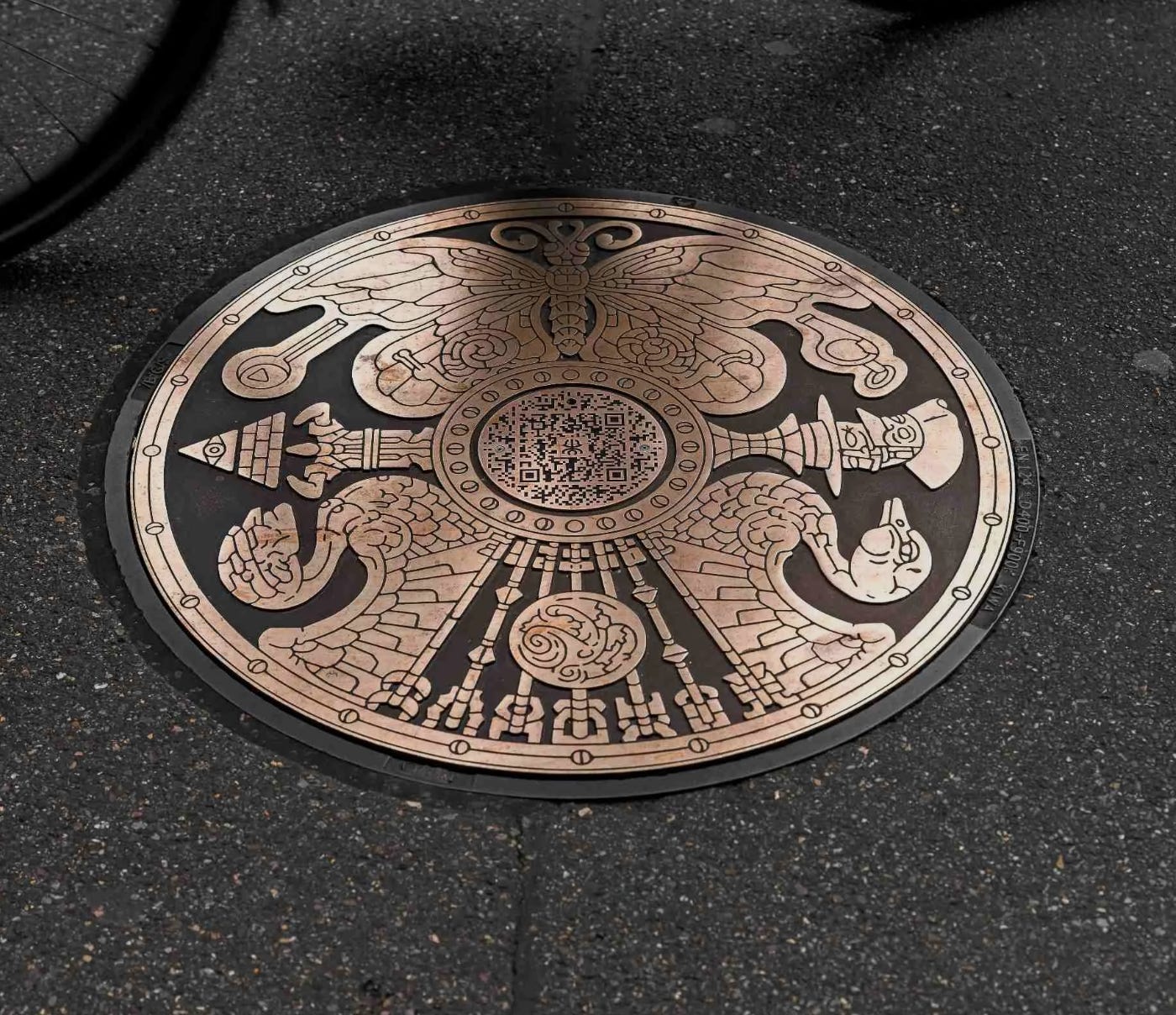
As entry points or portals for visitors, they developed six artistically designed manhole covers, placed at neuralgic points throughout the city of Zurich that reference Bratton’s layers. They further deepen the content of each on-site layer through augmented reality scenes accessible via QR codes. In doing so, they create multidimensional experiential spaces on location — spaces intended to make not only a complex theory, but technological lived realities, tangible.

Bildbeschreibung

Bratton’s theories are not simply adopted, but in a sense transposed into mythological references. The manhole engravings designed by Jules Durand allude to phenomena that are as real as they are consequential — such as surveillance and gentrification — while also bringing to mind demonic figures or the white rabbit from Alice in Wonderland. Through the manhole covers and the augmented reality scenes, the artists develop narratives that render the city of Zurich and the technologies shaping it as an almost fairy-tale-like complex scenery waiting to be discovered.

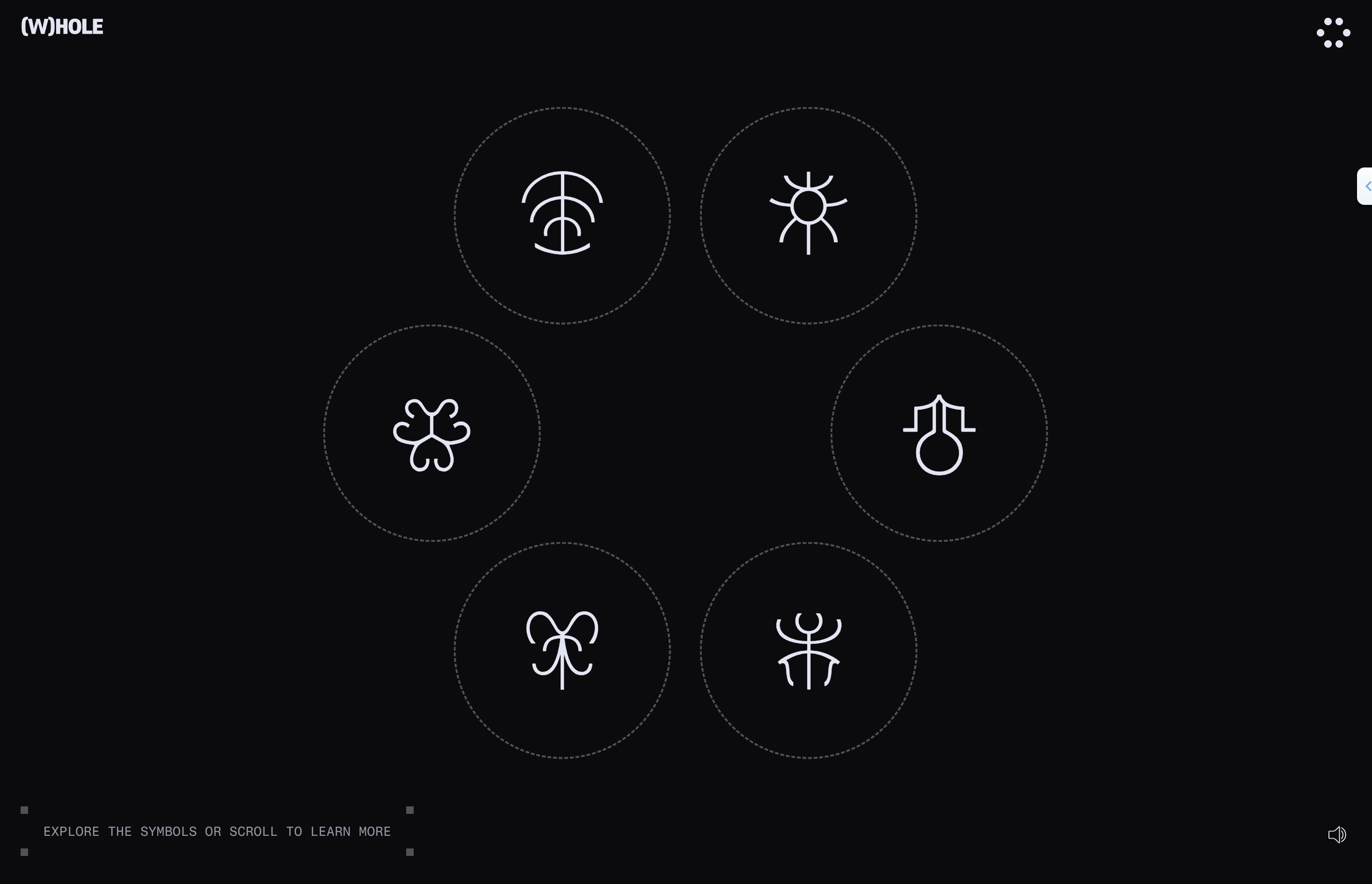
All of these layers are ultimately brought together on a webpage. This serves not only as an informational tool explaining the background of the individual engravings, but is intended to be activated as a “Living Archive” as the project develops further. The project website features a database pointing to texts and documentation, making scholarly and documentary contexts accessible to visitors. As the project evolves, this database is to be opened up for contributions from visitors. Through their web presence, Clusterduck makes clear that they aim not only to generate techno-aesthetic experiences, but also to convey foundational knowledge about the subject they have engaged with and to activate local knowledge.

Bildbeschreibung

The project website thus reveals the fundamental attitude that permeates The (W)hole: digital culture, as Clusterduck demonstrates here, is a collective phenomenon that can be activated both socially and aesthetically. In The (W)hole, the artistic object intertwines with the research question, the archive with the narrative, the exhibition with the platform. The work creates no closed spaces, but forms an experimental ecosystem that comes alive across various modes of access.

The project is thus positioned by the artists in a way in which art, research, digital infrastructure, speculative fiction, and collectively organized knowledge production become inextricably interwoven. The very title of the project hints at this multilayered quality: The (W)hole is simultaneously an exploration of the whole and an engagement with the holes, cracks, and abysses from which the digital emerges.

This approach is relevant because, historically, art was primarily bound to physical spaces — museums, churches, or public squares. Digital technologies have broken down these boundaries. They create new forms of the public that are no longer tied to place. Clusterduck thereby makes comprehensible that art today can also be received and produced through social media, digital platforms, and virtual networks. The artist collective thus points to transformations that concern not only the reception of art, but equally our very perception of space itself.

They do so at a moment when it has not yet been definitively established what significance digital technologies will hold for public space and for public art in particular. At present, constellations of power are constantly shifting within the context of the digital public; new “forums” are opening up within ostensibly neutral network technologies that have yet to be fully understood. If one takes seriously the current transformations of the public through digital technologies, the local presence of art is called into question. After all, we as recipients are by now without a fixed location ourselves. The internet accompanies us permanently, yet largely remains invisible: server farms are mostly located outside of cities, platform architectures elude perception, data streams remain closed to our senses.

Against this backdrop, The (W)hole unfolds, consequently, in a process of sense-making that connects the city: knowledge is conveyed here not linearly, but fragmentarily, interwoven, and open to expansion. The work links everyday urban life with the deep layers of the digital. It transforms places into speculative infrastructures. At a time when digital technologies are increasingly receding into the background while simultaneously remaining omnipresent, The (W)hole enables a rare, almost poetic experience: the moment when the invisible suddenly takes shape in urban space. Clusterduck's project is thus not placed in public space, but generates experiences of the public itself — as an ongoing process within the tension between city, art, technology, and their users.

The Deep History of Earthset Photographs

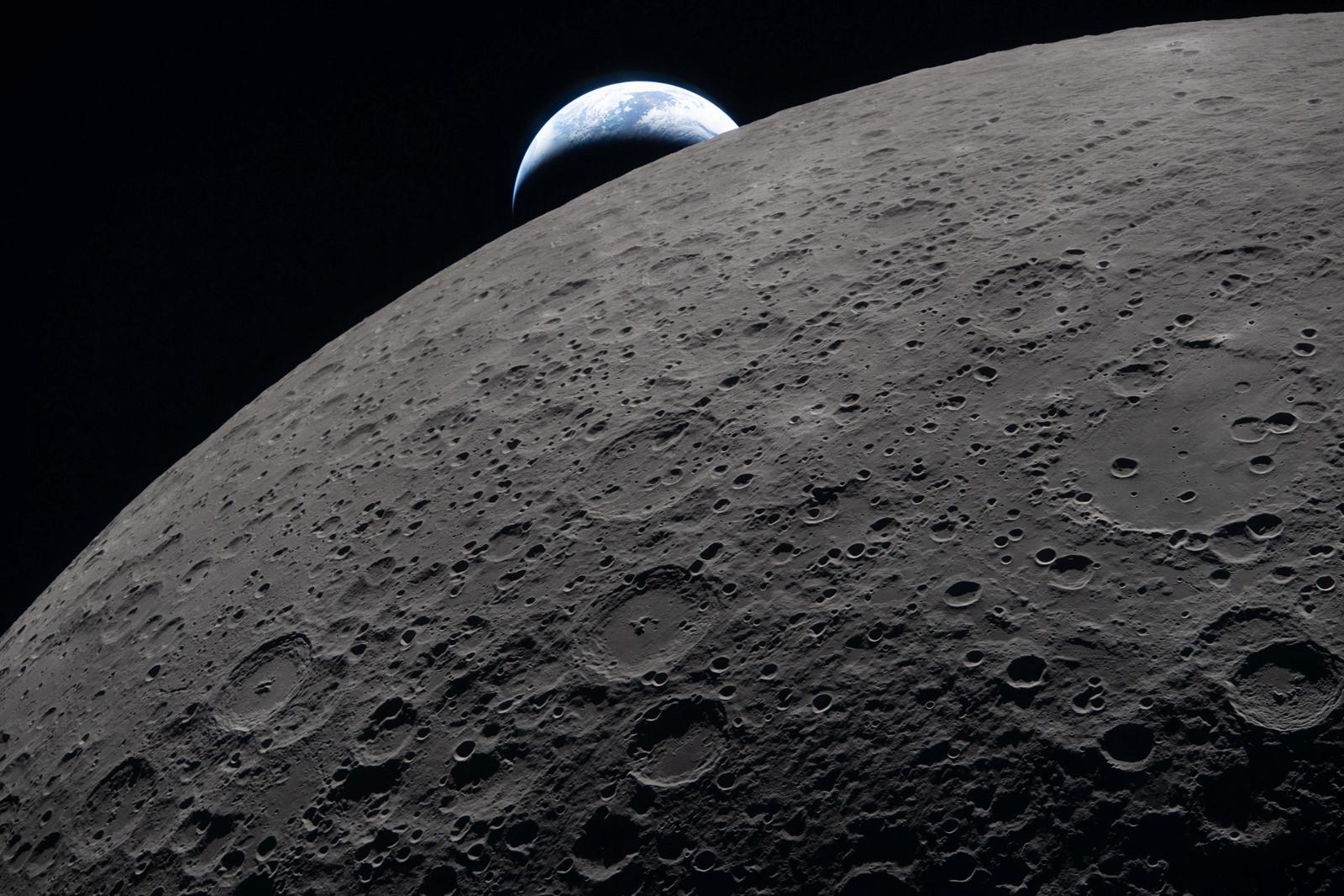
Lately, the Artemis 2 mission has blazed across our screens in a cascade of striking imagery. Millions of people followed the spacecraft’s journey around the Moon, and one photograph in particular captured widespread attention: an Earthset image showing our planet sinking behind the lunar horizon.

NASA, Photograph, 2026 NASA, Photograph, 2026
The image is immediately compelling. The moon surges massively into the foreground while the Earth glows against the deep black of space behind it. Its repeated circulation through the media is hardly surprising—this is a beautifully composed photograph. But in this article, I want to argue that the fascination it provokes runs deeper than pure aesthetics. A glance at the history of astronomical imagery reveals that this Earthset belongs to a long artistic genealogy, one that stretches back well over a century and has now found a vivid new expression.

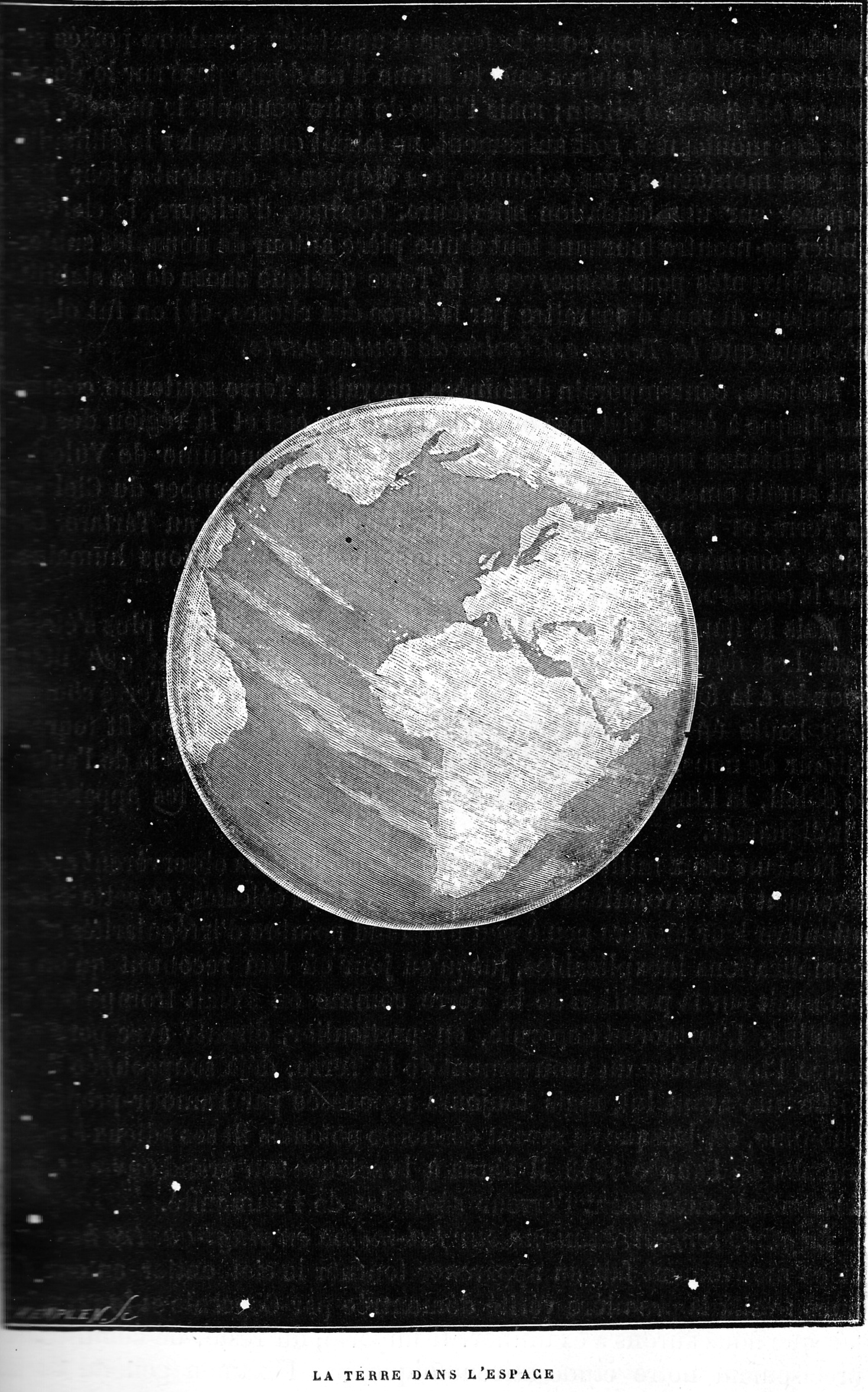
The way we visualize the sky owes a great deal to a man who was once a household name but has since fallen into near-total obscurity: the French astronomer and science popularizer Camille Flammarion. His book Astronomie Populaire from the year 1879 reached mass audiences across Europe, and its success rested on Flammarion’s rare gift for making complex—and sometimes frankly speculative—scientific ideas accessible and visually thrilling. The book was lavishly illustrated, offering readers a portal into fantastical, imagined landscapes. Among its opening images was a print by Flammarion’s house illustrator Kemplen that stands as one of the earliest relatively accurate Earth-in-space compositions in the history of astronomy.

Kemplen, La Terre dans l’espace, 1879 Kemplen, La Terre dans l’espace, 1879
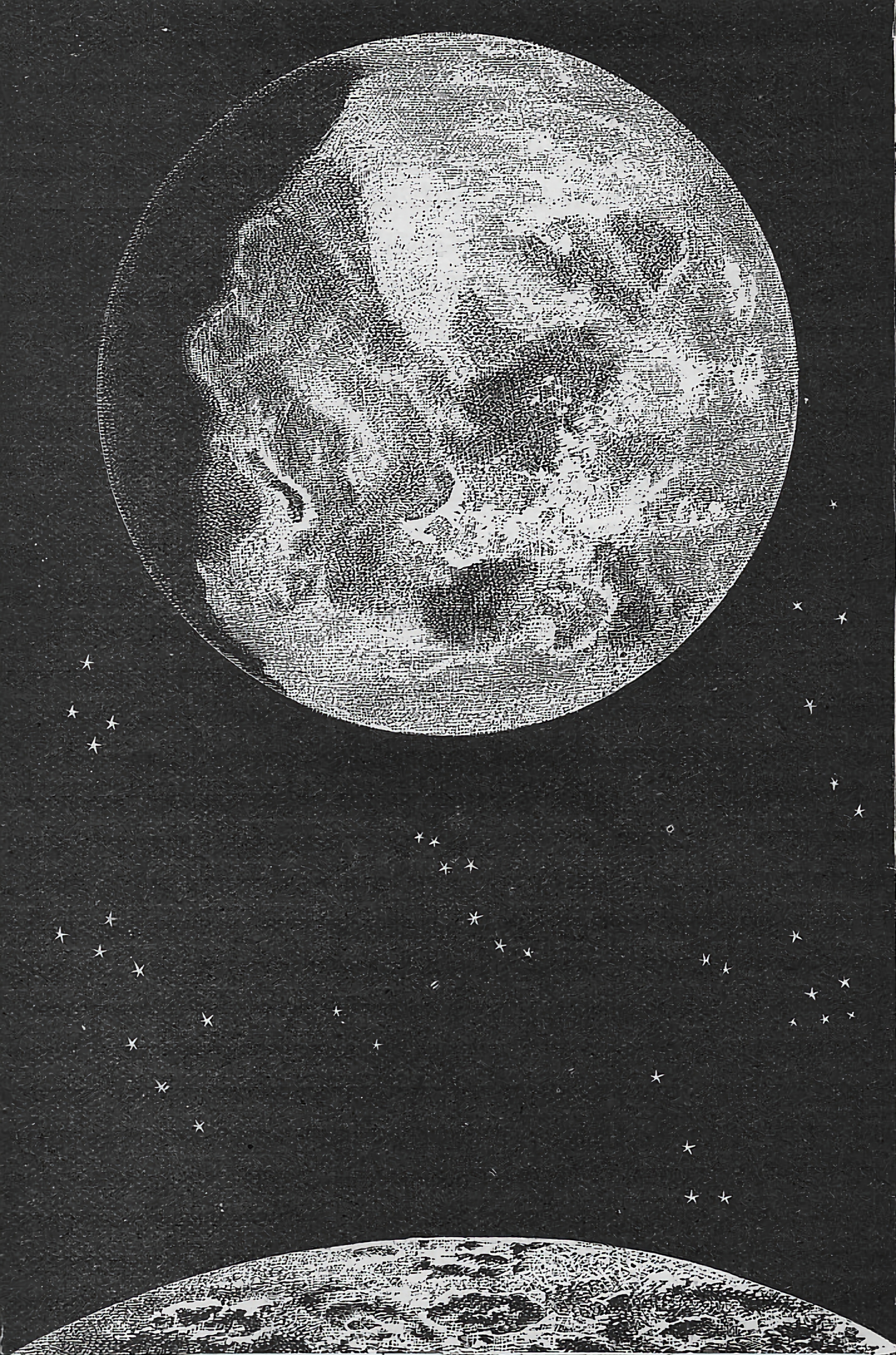
The title tells us what we are seeing: the Earth, viewed from the depths of space. Already, most of the visual elements that would later define Earthset photography are here in place. The viewer is invited to detach from earthly gravity and turn back toward the home planet. We might call this an early “special effect”—a manufactured perspective that no human had yet actually occupied.

The composition becomes still more explicit in the modified version of Flammarion’s illustration that appeared in the 1894 English translation of the book, published as Popular Astronomy.

Unknown illustrator, The Earth, as seen from the Moon, 1894 Unknown illustrator, The Earth, as seen from the Moon, 1894
Here the Moon itself enters the frame, and the image’s caption makes the vantage point explicit: we are looking at the Earth as a visitor to the Moon might see it. Though the lunar surface occupies the lower edge of the image—close to the viewer—the implied point of observation sits slightly above and behind it, suggesting a traveler in orbit rather than one standing on the ground. The compositional grammar of the Earthset image, shot from a spacecraft in lunar orbit, was already fully articulated in the late nineteenth century.

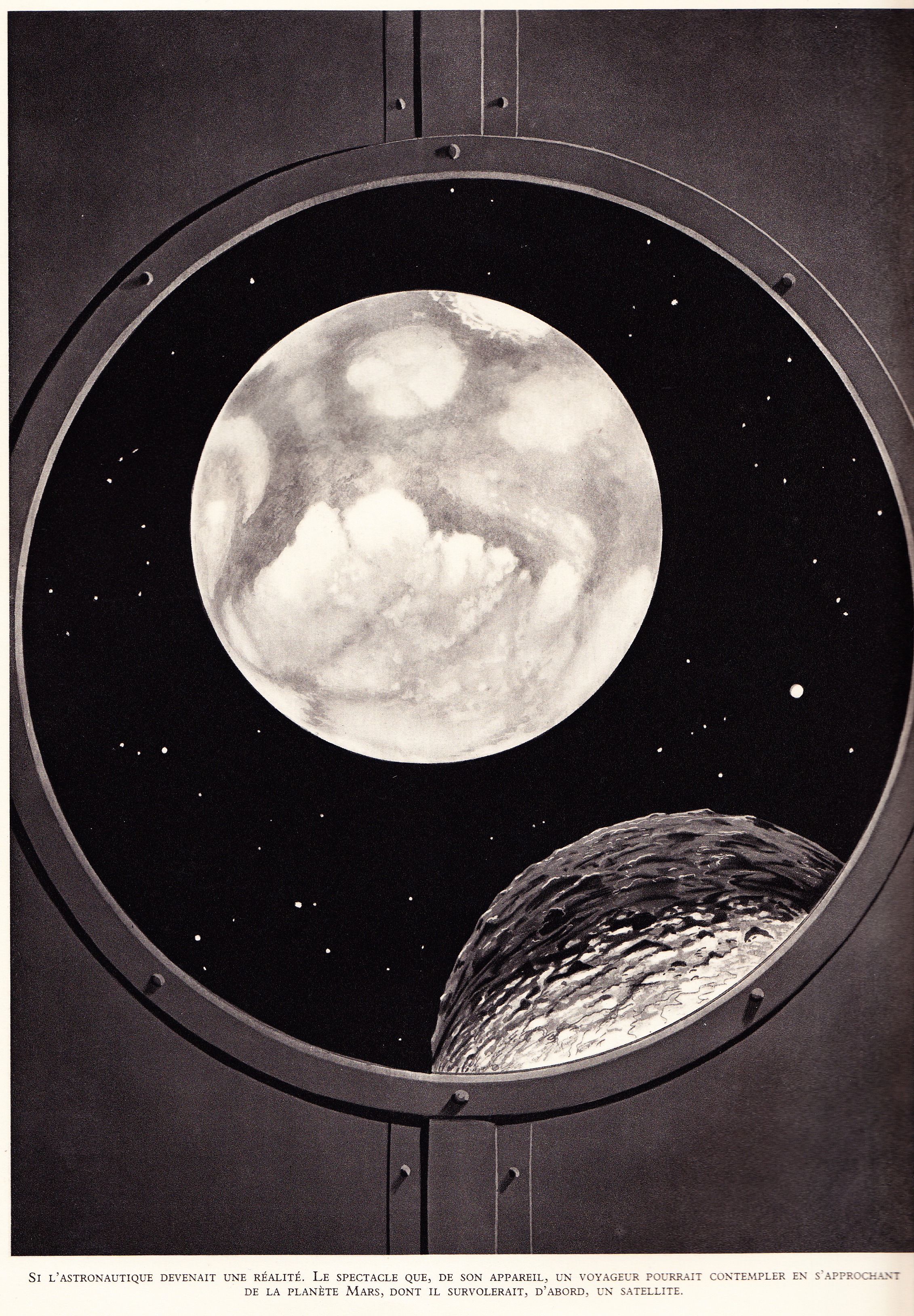
And the Earthset theme did not stall with Flammarion. It found a determined successor in the French astronomer Lucien Rudaux, whose book Sur les autres mondes (1937)—a kind of visual journey through astronomical history—opens, fittingly, with a quotation from Flammarion.

Lucien Rudaux, Painting, 1937 Lucien Rudaux, Painting, 1937
One of the central images in Rudaux’s book shows exactly what Flammarion had imagined: the Earth as it would appear to a visitor watching it from a spaceship situated above the Moon. Rudaux hence goes a step further. Where Flammarion had kept his observer in a kind of undefined aerial position, Rudaux places him firmly on a spaceship—a detail that obviously anticipates the coming age of (science fiction) spaceflight and the very real possibility of human beings traveling through outer space.

The decades between Rudaux and the Apollo program were, of course, not without relevant outer space images. From the 1940s onward, science fiction cinema developed its own rich tradition of Earthset-like imagery in films like Destination Moon and The Conquest of Space, building on the iconography of popular astronomy while loading it with technological ambition. That lineage connects back further still, to Jules Verne—but it is a story large enough to require its own article.

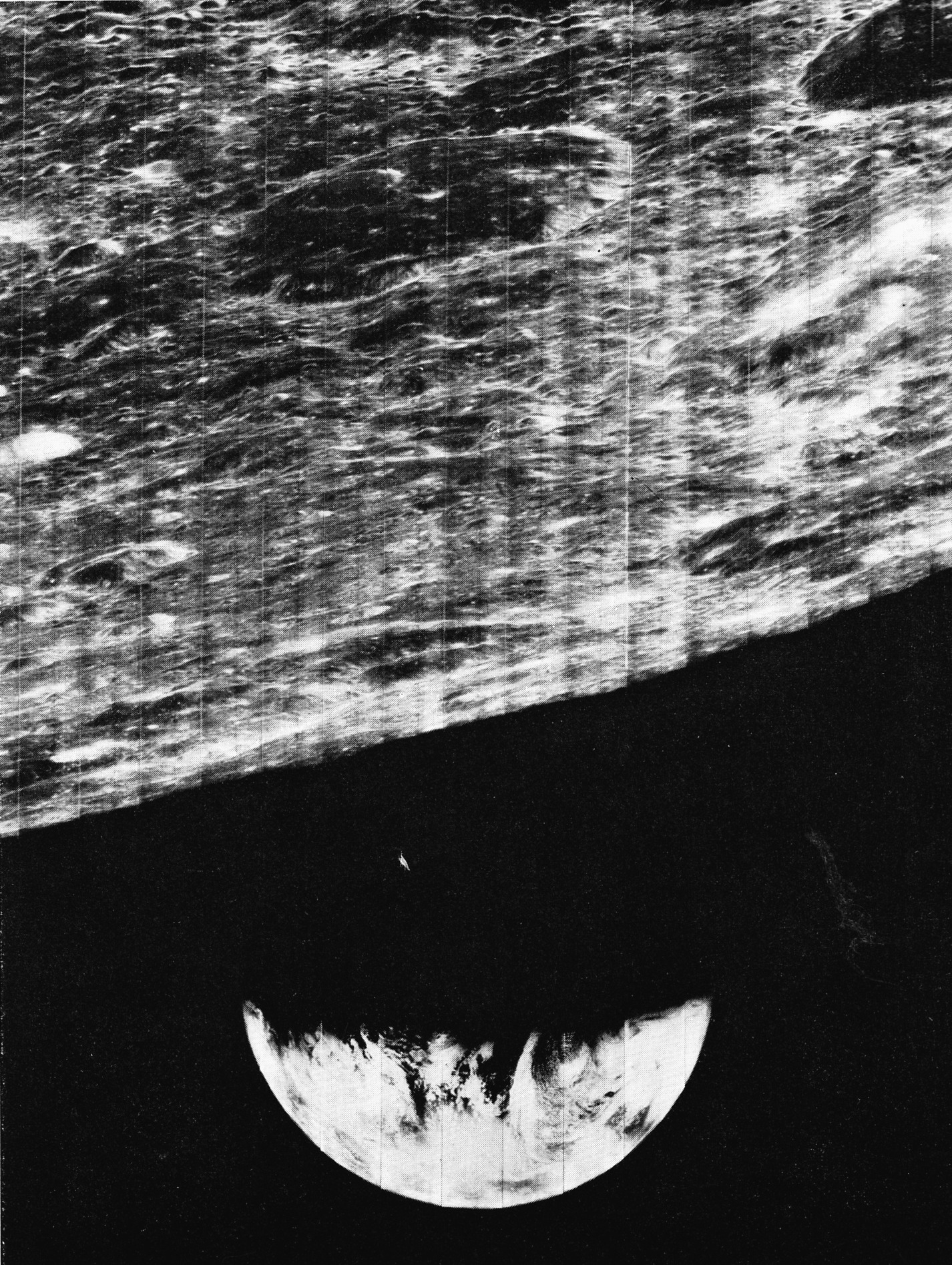
The first photographs to truly test the predictions of astronomers like Rudaux arrived with NASA’s Lunar Orbiter program, launched in 1966. The program’s official mandate was photographic mapping of the lunar surface to identify viable landing zones for the Apollo missions—a goal at once technical and strategic. But among the images the orbiters returned was something that looked uncannily familiar.

NASA, Photograph, 1966 NASA, Photograph, 1966]

Seen from lunar orbit, Earth hangs as a distant crescent above the Moon’s surface. Flammarion’s speculation had become fact.

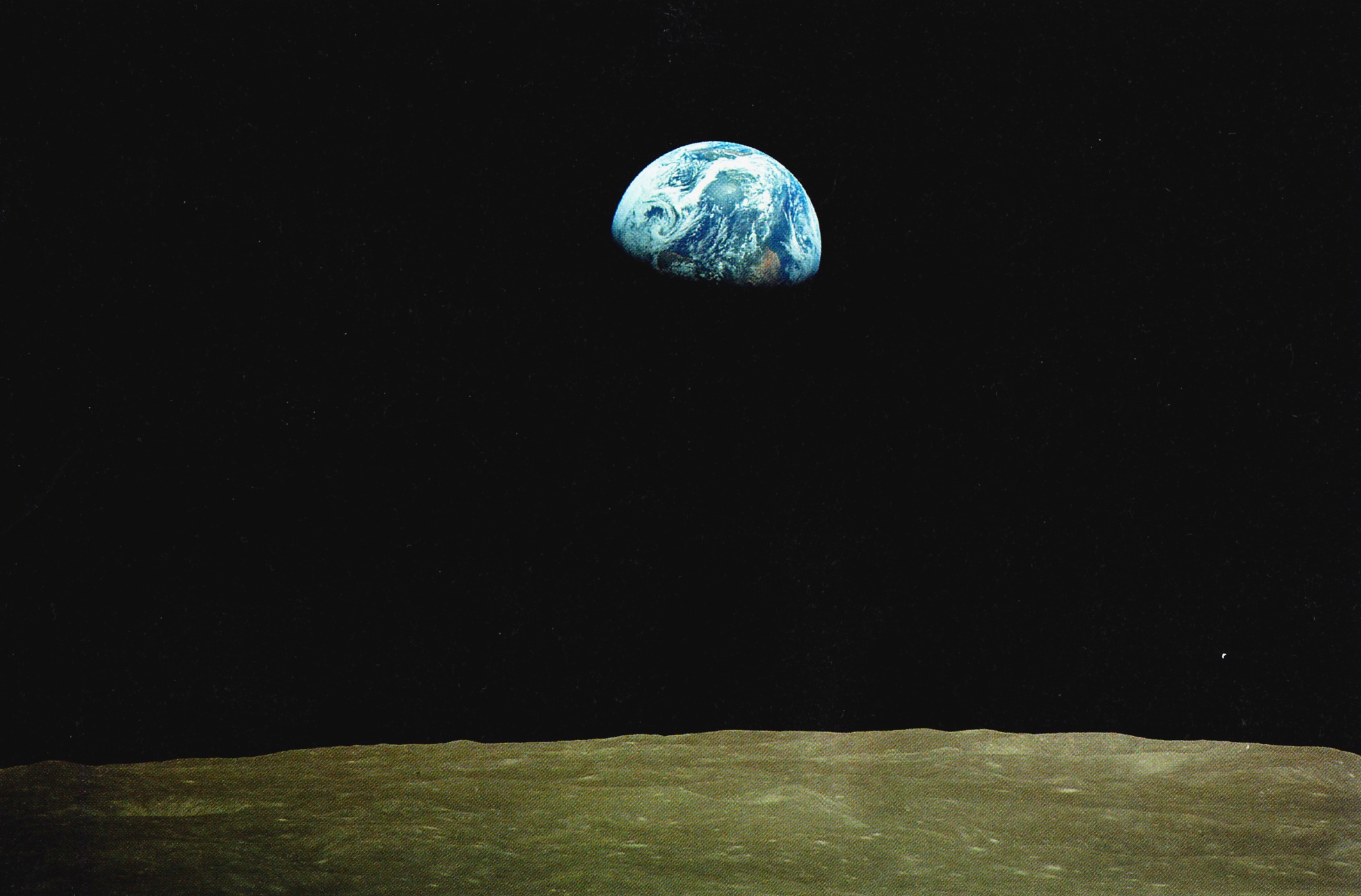
Two years later, in December 1968, the first humans traveled around the Moon. And in the course of that journey, one of the most iconic photographs in history was made: the so-called Earthrise.

NASA, Photograph, 1968 NASA, Photograph, 1968

The cultural impact of this photograph was immense. The image became a touchstone for the emerging environmental movement and a rallying symbol for figures like Stewart Brand, whose Whole Earth Catalog drew much of its philosophical energy from the experience of seeing the planet whole from space.

On the surface, Earthrise might seem to be the inverse of the Earthset motif—one shows the Earth rising above the lunar horizon, the other shows it sinking below. But the distinction is less stable than it appears. The original photograph was taken with the Earth appearing to the left of the Moon’s horizon; the canonical version we all know has been rotated ninety degrees, repositioning Earth above the horizon in a rising arc. Perspective in space resists the orientations we impose on it from Earth. In any case, the kinship between the two images is unmistakable.

What Earthrise shows, like the Earthset images that preceded and followed it, is a view that once belonged entirely to the imagination—and that now, again, is becoming real. When we look at the Artemis 2 Earthset, we are not simply looking at a remarkable photograph. We are, I would argue, responding to a visual tradition that has shaped how we expect the universe to look: a tradition constructed from centuries of longing, speculation, and artistic invention.

The way we penetrate the unknown has always been scripted—by narratives, desires, and inherited images. All of this condenses in the Earthset motif. That, more than any inherent drama in the subject matter, is what makes these photographs so powerful. The cosmos offers endless spectacles. But the images that move us are the ones that speak to something we have already, in some sense, seen before.

The Artemis 2 Earthset does not show us something revolutionary. It shows us how deeply we remain rooted in the visual languages of our past—and how those languages continue, quietly and irresistibly, to shape what we see when we look outward.