Image Machines. Artistic image creation beyond the simulacrum
Photography and video, in their technical resolution, are reference media of our time. We have grown accustomed to photography as daily reality: digital storage media and the almost unlimited visual access to our environment afforded by smartphone cameras have made photography and increasingly video our permanent companion. What is less apparent in everyday life is that in the course of this process, the way images come into being has itself changed profoundly. The images and videos that circulate dominantly today are no longer classical products of the technical output of a camera obscura; they are results of computational processes. These images are no longer drawn by the mere incidence of light, by a “pencil of nature”. Instead, “image machines” are assembled from data. These machines negate the classical order of objectivity in both senses of the word: its reference to objects and its claim to intersubjective validity. The thesis of this essay is that with these pictorial image machines an order is coming to an end that has governed our pictorial imagination and with this our concept of the world for centuries: the order of central perspective.
To explain this claim, it is necessary to take a step back. Photography and video as we know it today builds, in terms of cultural history, on the camera obscura and the associated concept of central perspective. Both the camera obscura and central perspective organize representations, technically as well as conceptually, around a central axis of vision. What is seen is made visible from a single point, as if through a peephole. In this respect, central perspective in particular is a foundational instance of European art history. And central perspective did not merely organize images; it organized the world and perception, as Erwin Panofsky classically argued in Perspective as Symbolic Form. It was meant to make what is to be seen around us geometrically, and thus objectively, describable. The following illustration by Leon Battista Alberti, who first codified central perspective in De pictura (1435), shows well how this was done.
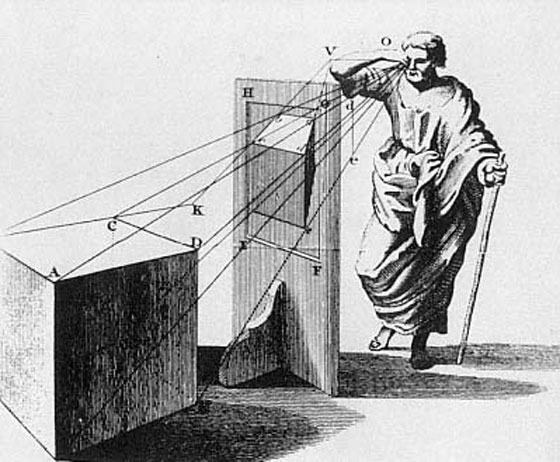 Leon Battista Alberti, “Illustration”, 1435.
This illustration quickly makes clear that things are here opened up and explained from the perspective of a beholder. The world here emerges from the perspective of an idealized, posited gaze. It is organized accordingly into different layers of depth: into foreground, focused image centre, and background. Central perspective is essentially a mathematical system of rules that helps us categorize the world as a pictorial construct.
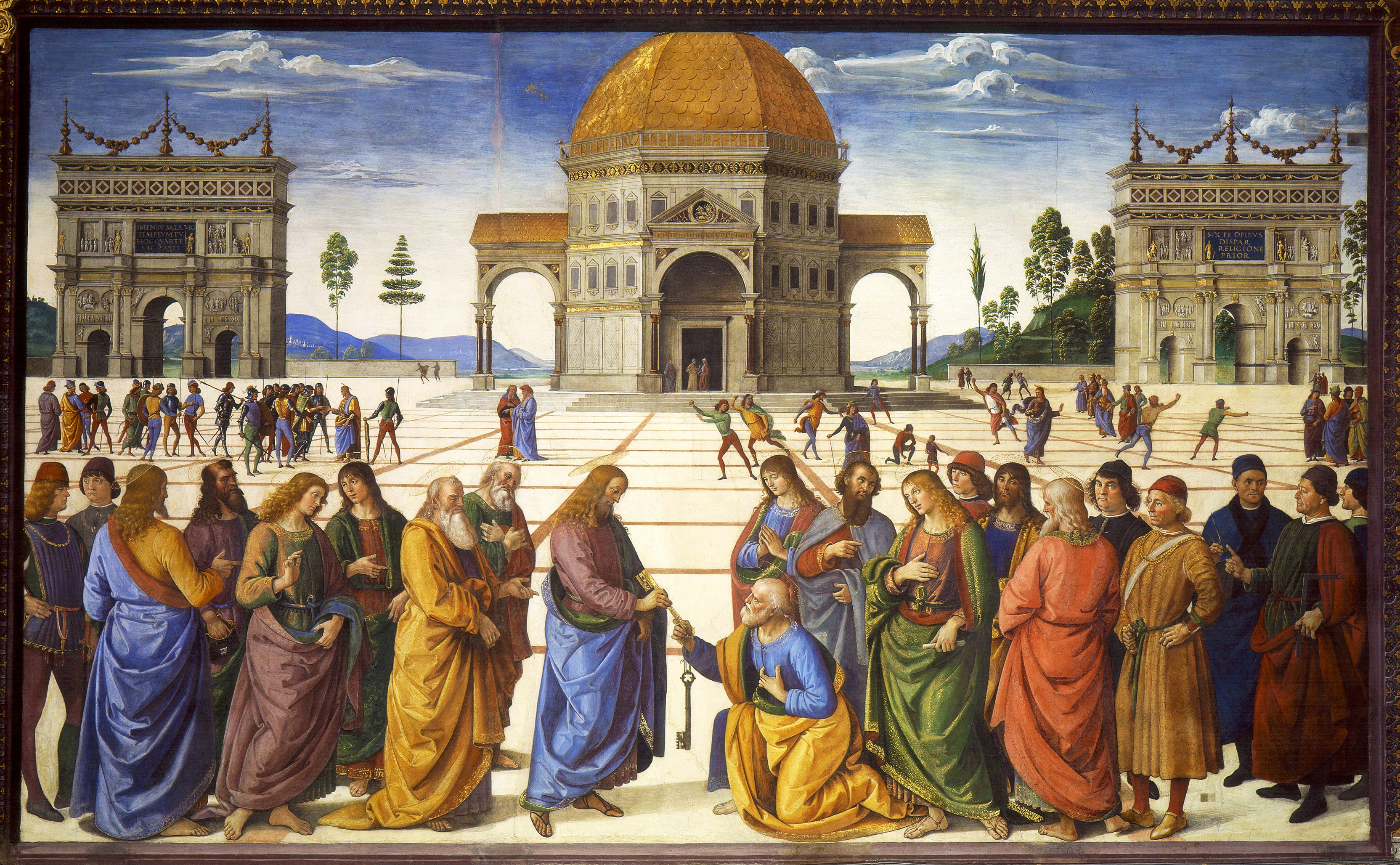 Pietro Perugino, Consegna delle chiavi, 1481 – 82.
In terms of cultural history, the central perspective is not only relevant for artists – it is a tool for describing the world. The emergence of the European natural sciences can also be linked, in terms of the history of mentalities, to the central perspective. Crucial to the natural sciences, too, was the experimental order of an “as if,” in which personal perception was not merely to be described but made verifiable. The term “objectivity” nicely reflects what resonates here. If we bring into view only the objects themselves, as they unfold before us in perspective, then intersubjective positings become possible – and with them, assumptions of truth. And the efficacy of these assumptions of truth for European as well as global cultural history can hardly be overestimated.
At this point, I have to make a leap. In terms of cultural history, there would be numerous further points to raise here, which cannot be accomplished in an essay that ultimately places contemporary phenomena at its centre. My primary concern here is to mark out a historical context. May I be forgiven, then, for now, jumping almost directly into the present.
Cybernetics With the emergence of cybernetics and the digital tools it made possible, the way we appropriate our world changed profoundly. The latent spaces of the data realm are the multidimensional feature spaces in which computerized machines internally organize what they process. This information-based digital space of computerized machines does, superficially, build on structures similar to those of the classical world-space spanned by central perspective. However, and here lies the central difference, it no longer builds on objective conceptions of world, but places information, or rather digital representations of “things,” at the centre – representations that no longer commit themselves primarily to a referent in the world.
The things of the present, so it can be claimed, are no longer parceled out in central perspective within our image-making but are appropriated, categorized, and stored as units of information by our current digital technologies. Following this development, photographs and videos in particular have, since the late 1990s, become digitally de-objectified objects. This dynamic became accessible to the general public at the latest with the emergence of computer programs such as Photoshop. With the help of such programs, it became possible to intervene retroactively in images, that is, in their informational basis. At the same time, a broad public came to understand to what extent the computerized data space had begun to transform our very concepts of reality. To be clear, photographs could always be manipulated – retouching and montage are as old as the medium, as John Heartfield’s photomontages demonstrate. What was categorically new is that digital images consist of nothing but their manipulable informational basis: intervention no longer worked against the image; it became its mode of existence. Since then, we have been living in what Jean Baudrillard called a time of simulacra (Simulacra and Simulation, 1981). Simulacra, in Baudrillard’s sense, are signs that no longer conceal a truth behind them but take its place – copies without originals. We experience a time emptied of objective assumptions of truth – one that can be permanently overlaid by categorizations and interventions from the computerized information space.
And constant access to the informational basis of the “world-images” that surround us and that we produce has long since become normality. A digitally produced image today hardly differs, superficially, from its analogue counterpart. Various artists, however, have adapted aesthetically to this new “reality.” The photographs of Andreas Gursky, for instance, have shown well since the early 2000s that precisely the classical division into foreground, image centre, and background need no longer play any role for digital photography. His by now classic depictions show hyperreal sceneries; they show multiperspectival ruptures that no longer have anything to do with analogue photography.
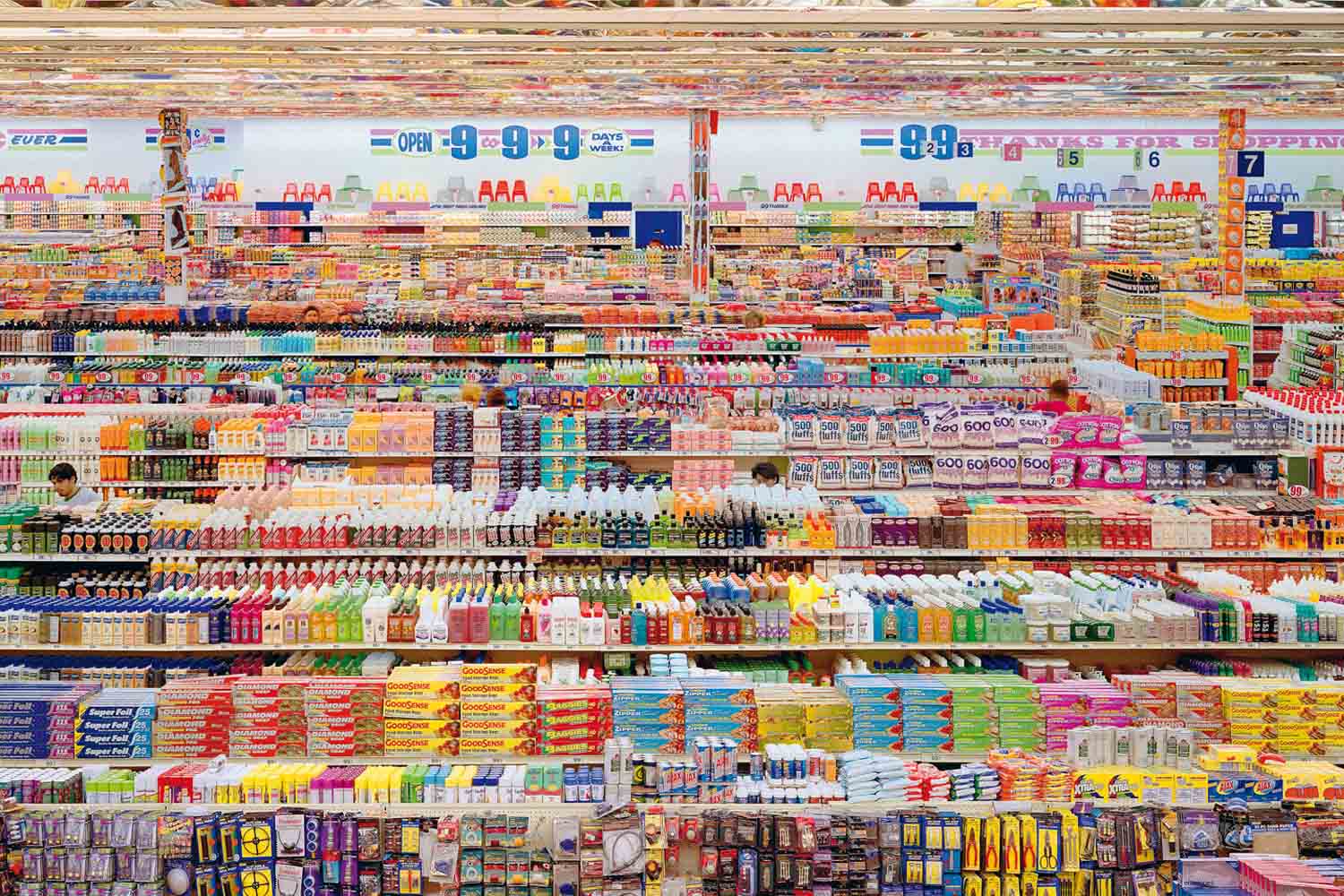 Andreas Gursky, 99 Cent II, Diptychon, 2001.
What this means can be shown using the example of 99 Cent II, Diptychon. In this artwork, there is no clear image centre, but only, as it were, clustered, superimposed image axes. Here everything is meant to be visible without restriction – no ray of light and no axes of vision organize our gaze. The organization of the image migrates into image-immanent systems of reference that show everything and no longer focus on anything. These images thus dissolve, as it were, into information. They present themselves as compositions perforated by diverse interventions.
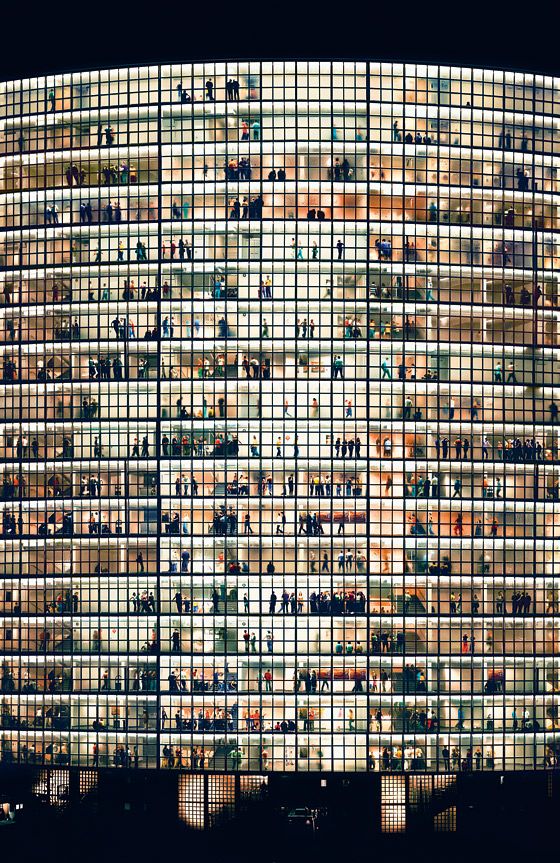 Andreas Gursky, May Day V, 2006
This development has by now arrived even in consumer photography. As the well-known tech blogger Marques Brownlee explains in his video “Why New Smartphone Cameras Feel Worse” (published on YouTube on 11 May 2026) a wide variety of algorithmic image-processing operations running in the background have long since penetrated general consumer photography. These operations range from multi-frame stacking to semantic segmentation, which treats faces, skies, and foliage as separately optimizable objects.
Marques Brownlee, Why New Smartphone Cameras Feel Worse, 2026
What Brownlee laments in his video about the new, hyper-processed image aesthetic of contemporary smartphone photography is the complete leveling of all structures of image organization. Nothing in these images remains in shadow any more – everything is pushed, as it were, side by side into the foreground. This produces an image aesthetic of Gurskyesque radiant artificiality. One could claim in this context that the algorithmic processes inscribed in modern smartphone cameras condense, in Gursky-like fashion, the image material produced by users through technical interventions. What these cameras generate, then, is an aesthetic that is no longer showing anything specific. Baudrillard, one might claim here, has become pop culture at least today.
The phenomena described are more or less widely discussed – I am primarily tracing a line of discourse here. At present, however, a further step is beginning to announce itself, or so I want to claim: the processes described are being radicalized once more through recourse to AI technologies. What I want to bring into view in what follows, then, is a further detachment from the concept of an objectively comprehensible world, which is presently being played out to the full by artists. And I would claim that this development is already graspable as an upcoming dynamic in the broader consumer culture.
Artistic detachment Even if it remains fundamental to this day that information-based images allow unlimited interventions in their data structure and thus also in their visible surfaces, reception has for the most part remained confined to images and image perspectives that “simulate” objectivity. It is this claim of simulation itself, I want to argue, that is now being called into question by technically engaged contemporary artists. The difference is decisive: Photoshop intervened in images that continued to look like central-perspectival world; its manipulations were directed at surfaces that upheld the claim of depicting something. The phenomena discussed below abandon this claim itself – they no longer simulate a view onto the world but exhibit the technical conditions of image production itself. I will call these phenomena in what follows image machines.
Crucial for my argumentation are two contemporary artists, Anton Elfilter and Karlo Lovrenščak aka Mezotes, whose positions I read as exemplary of this shift. Both artists work extensively with AI technologies and, with the help of these current technologies, detach themselves ever further from the appearance of an objective reality. Both artists – and I consider it particularly important to emphasize this – no longer produce (simulated) depictions of existing or fantastic realities. One could say: if every computationally produced image today is latently an image machine, these two artists make that latency explicit – they exhibit the machine in the image. Elfilter and Lovrenščak thus work, as I want to show, against the cultural-historical “weight” of central perspective. They dissolve systems of reference that have accompanied us for hundreds of years and have shaped the way we deal with the world. The works discussed below were published by both artists on their Instagram accounts in 2026 and are cited here from that context.
Anton Elfilter’s AI compositions show beautifully what happens when the image composition itself is broken down into dynamic clusters, with even text, and traces of code being adopted as image values.
Elfilter, Video 1: Anton Elfilter, elfiltera-Dasq8eRDEnj, 2026. Published on Instagram https://www.instagram.com/elfiltera/, accessed 17 July 2026
In this composition, overlapping lines of movement are brought together in a single image space. It is this contradictory unity that also characterizes most of the compositions described in what follows. Here, vertical depictions of, for example, classical trains running on rails, together with textual elements likewise running vertically across the screen, are contextualized by landscape depictions that unfold mostly horizontally. The composition is thus marked by image elements moving in different directions at different speeds. One could speak of a “Wimmelbild” – a teeming picture – were this not so evidently clearly organized.
Elfilter, Video 2: Anton Elfilter, elfiltera-Dasq-LmjFY2, 2026. Published on Instagram https://www.instagram.com/elfiltera/, accessed 17 July 2026
The second composition superficially stabilizes our visual access with larger visual elements. Within it, however, the dynamics of movement are heightened by faster-running image elements. What is intriguing here, too, is that the apparently condensed depictions of nature are now overlaid with a more considerable number of textual lines of movement. Nature sceneries, presumably extracted from postcards, thus unfold here in superimposition with recordings of displays and the text running across them. As if on conveyor belts, images are fed to us here in horizontal bands and counterpointed with technical recordings. This is the composition’s distinct argument: everything about it reveals itself as image machine, while the content defined by a postcard idyll recedes into mere material.
Elfilter, Video 3: Anton Elfilter, elfiltera-DavV1majOTU, 2026. Published on Instagram https://www.instagram.com/elfiltera/, accessed 17 July 2026
This third composition presents forms that constantly re-fragment themselves, not only at different speeds but also in their directions of movement. Images of flowers do not merely run abstractly across the display here – in the lower right third, they are even splintered into abstract forms. An inkling arises here of the aesthetic qualities the flower templates once originally possessed. The image space thereby takes on something lovely and yet keeps tipping, again and again, into the abstract visuality of geometrically fanned-out display surfaces. Here, too, the perspectival order is absent. Everything dissolves in technological dynamics, remains legible only in references. The technical mediality of the image is thus pushed, almost forcibly, into the foreground. This image machine brings the appearance of classical beauty into view, only to let it founder in the dynamic image clusters of a composition.
Elfilter, one could superficially claim, is working through the potential artificiality of AI-generated images. Such a claim, however, would not rate highly enough the deliberate dynamization of the image surface, the artist’s evident will to form. These compositions peel out the digital information space and its aesthetic potentials, unbounded by AI technologies, beyond and against the visual codes of (simulated) central-perspectival assertions of the world. What is important here is that these are evidently not glitches, not deliberately addressed errors, but consciously assembled compositions that assert an aesthetic autonomy of their own. What is being worked on here are image machines that set themselves apart from historical assertions of the world. They do so by pushing the technical layers of the visible into the image until these layers become more dominant than what is depicted.
Karlo Lovrenščak aka Mezotes works in a comparable, yet more theatrically staged, manner than Elfilter. In his work too, dynamic, moving image axes are superimposed. Lovrenščak also works, as I want to suggest, on image machines that make their own artificiality their theme. The artist, however, thinks more sculpturally than Elfilter. He stages the seeming artificiality of his images not primarily in superimpositions but as a total ensemble unfolding, as it were, sculpturally. This becomes apparent when one considers the following composition.
Mezotes, Video 1: Karlo Lovrenščak aka Mezotes, mezotes-DW6b1TciLf7, 2026. Published on Instagram https://www.instagram.com/mezotes/, accessed 17 July 2026
Here, too, bands of images run toward us. The axes of movement, however, are defined here image-immanently. They are organized within an overall composition, which becomes especially clear at the very centre of the image, where the depictions running toward one another almost begin to strike sparks. The textually and visually determined image space is thus posited here as something that seeks less to play across the image surface than to fill it with a form. The artist’s will to design thus becomes even more clearly legible here than it was the case with Elfilter. Here, radicalized as against the position defined above, the following holds: this image machine brings into view only the appearance of naturalness of the source material in order finally to let it be absorbed into a dynamic image clusters.
Mezotes, Video 2: Karlo Lovrenščak aka Mezotes, mezotes-DYPWtgfjQev, 2026. Published on Instagram https://www.instagram.com/mezotes/, accessed 17 July 2026
In the second composition I cite here, too, the artist points beyond the image space – or rather intervenes sculpturally within it. At the centre, a person remains visible, directly addressing the beholder. The image frame, or background, however, is dissolved into rasters at times reminiscent of data grids, only to tip later into an image space resembling rock faces. Traces of code and data grids, it can be claimed, are in this composition transferred (in a visually graspable way) into objective surface structures. Digital image space and simulated depictions of analogue patterns blur here into an encompassing image narrative. Code becomes a waterfall – the image unfolds from aesthetic ciphers of digital image aesthetics toward an analogically legible image spatiality. And with the yellow tinsel, he lets rain down in the course of the piece, the artist himself parodies this very transformation. The image machine staged here shows its own mode of functioning, and shows how it unfolds pictorial depth out of technical processes. Here, too, the formula defined above holds: the technical layers of the visible dominate what they depict.
Mezotes, Video 3: Karlo Lovrenščak aka Mezotes, mezotes-DYPWtgfDQTR, 2026. Published on Instagram https://www.instagram.com/mezotes/, accessed 17 July 2026
In his third composition included here, Lovrenščak once again focuses on a digital “hinge” staged sculpturally within the image. Between landscape and sky, a digital image cluster rotates upward, letting images showing mountain landscapes from above spin ever further into themselves. This image spiral seems to screw itself into the vault of the sky – which in turn seems almost to bulge outward to absorb the spiral into itself. What this description alone shows well: nothing about this depiction is legible as natural anymore. In the ensemble, the machinic itself is moved to the centre. It is made legible. Lovrenščak, it can thus be claimed, generates narratives utilizing his image machines. He makes technical positions of mediation visible. In his abstract, almost sculptural ensembles he makes clear that artificiality and naturalness have long ceased to be categories interesting to him. What is interrogated instead are the modes of functioning of technologies such as AI and the aesthetic possibilities that result from them.
The cultural-historical “weight” of the central perspective, which I made a strong case for at the outset of this essay, plays no central role for Lovrenščak and Elfilter anymore. Their image worlds rotate within themselves and within the narratives they shape. The function of reference to an outside is itself regarded as so superfluous here that it remains legible at most as a secondary reference to the modes of functioning of technologies. Aesthetically and visually, then, image models are being developed here for a present that no longer regards even simulations of the real as central. This is where the present moves beyond Baudrillard: his simulacra still lived off the reference to a real they displaced; the image machines described here no longer even raise that claim. And this rupture, I want to argue, can be understood as a kind of artistic analysis of the present. The precedent is instructive: Gursky’s aesthetic of total visibility took barely two decades to migrate into the processing pipelines of smartphone cameras. It remains to be seen, accordingly, when and in what way this analysis will also represent itself in the algorithms relevant to consumer electronics. Hence, one can claim: The world, as it emerged from the perspective of an idealized, posited gaze has lost its relevance according to the artists cited here. The rule is abandoned, and the artists turn to new AI players, allowing them to re-define the depictions of reality itself.
Résumé The world as it emerged from the perspective of an idealized, posited gaze has, according to the artists cited in this essay, lost its status as law. What remains for them of central perspective and its layered order is citation material. From this observation, a thesis can be derived: the image machines of Anton Elfilter and Karlo Lovrenščak aka Mezotes do not simply add another chapter to the history of digital image manipulation – they mark the point at which images cease to assert the world at all. Where the camera obscura promised objectivity, and where Photoshop and smartphone algorithms still simulated it, these AI-based compositions push the technical layers of the visible into the image as more dominant than anything they depict. The reference to an outside becomes secondary; the machine itself becomes the subject. If the central perspective once made the world describable as image, the image machines of the present make images describable as machines. And it is precisely this reversal, I want to claim, that constitutes a valuable artistic analysis of our present.