We Have Seen This Before
The Deep History of Earthset Photographs
Lately, the Artemis 2 mission has blazed across our screens in a cascade of striking imagery. Millions of people followed the spacecraft’s journey around the Moon, and one photograph in particular captured widespread attention: an Earthset image showing our planet sinking behind the lunar horizon.
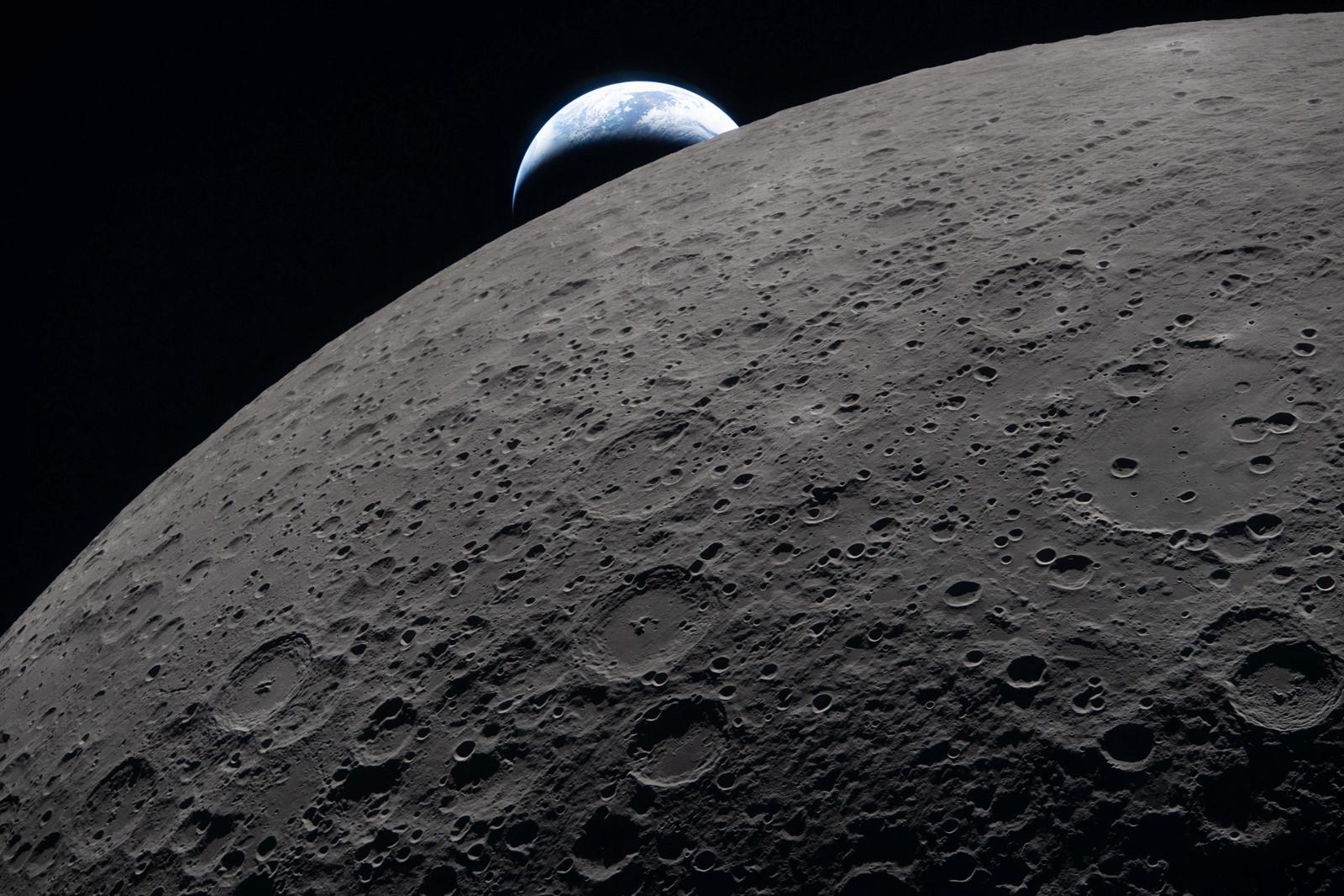 NASA, Photograph, 2026
The image is immediately compelling. The moon surges massively into the foreground while the Earth glows against the deep black of space behind it. Its repeated circulation through the media is hardly surprising—this is a beautifully composed photograph. But in this article, I want to argue that the fascination it provokes runs deeper than pure aesthetics. A glance at the history of astronomical imagery reveals that this Earthset belongs to a long artistic genealogy, one that stretches back well over a century and has now found a vivid new expression.
The way we visualize the sky owes a great deal to a man who was once a household name but has since fallen into near-total obscurity: the French astronomer and science popularizer Camille Flammarion. His book Astronomie Populaire from the year 1879 reached mass audiences across Europe, and its success rested on Flammarion’s rare gift for making complex—and sometimes frankly speculative—scientific ideas accessible and visually thrilling. The book was lavishly illustrated, offering readers a portal into fantastical, imagined landscapes. Among its opening images was a print by Flammarion’s house illustrator Kemplen that stands as one of the earliest relatively accurate Earth-in-space compositions in the history of astronomy.
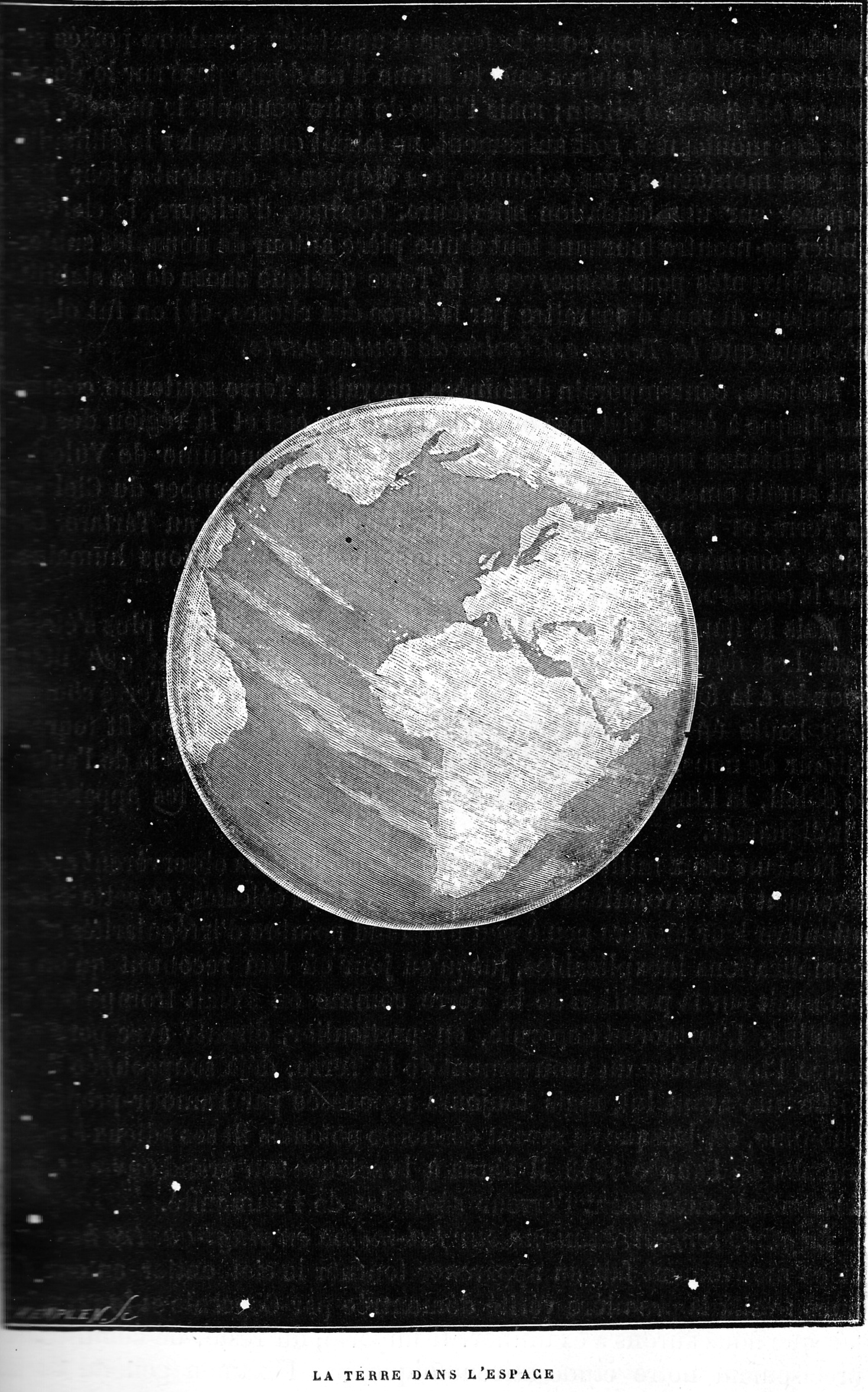 Kemplen, La Terre dans l’espace, 1879
The title tells us what we are seeing: the Earth, viewed from the depths of space. Already, most of the visual elements that would later define Earthset photography are here in place. The viewer is invited to detach from earthly gravity and turn back toward the home planet. We might call this an early “special effect”—a manufactured perspective that no human had yet actually occupied.
The composition becomes still more explicit in the modified version of Flammarion’s illustration that appeared in the 1894 English translation of the book, published as Popular Astronomy.
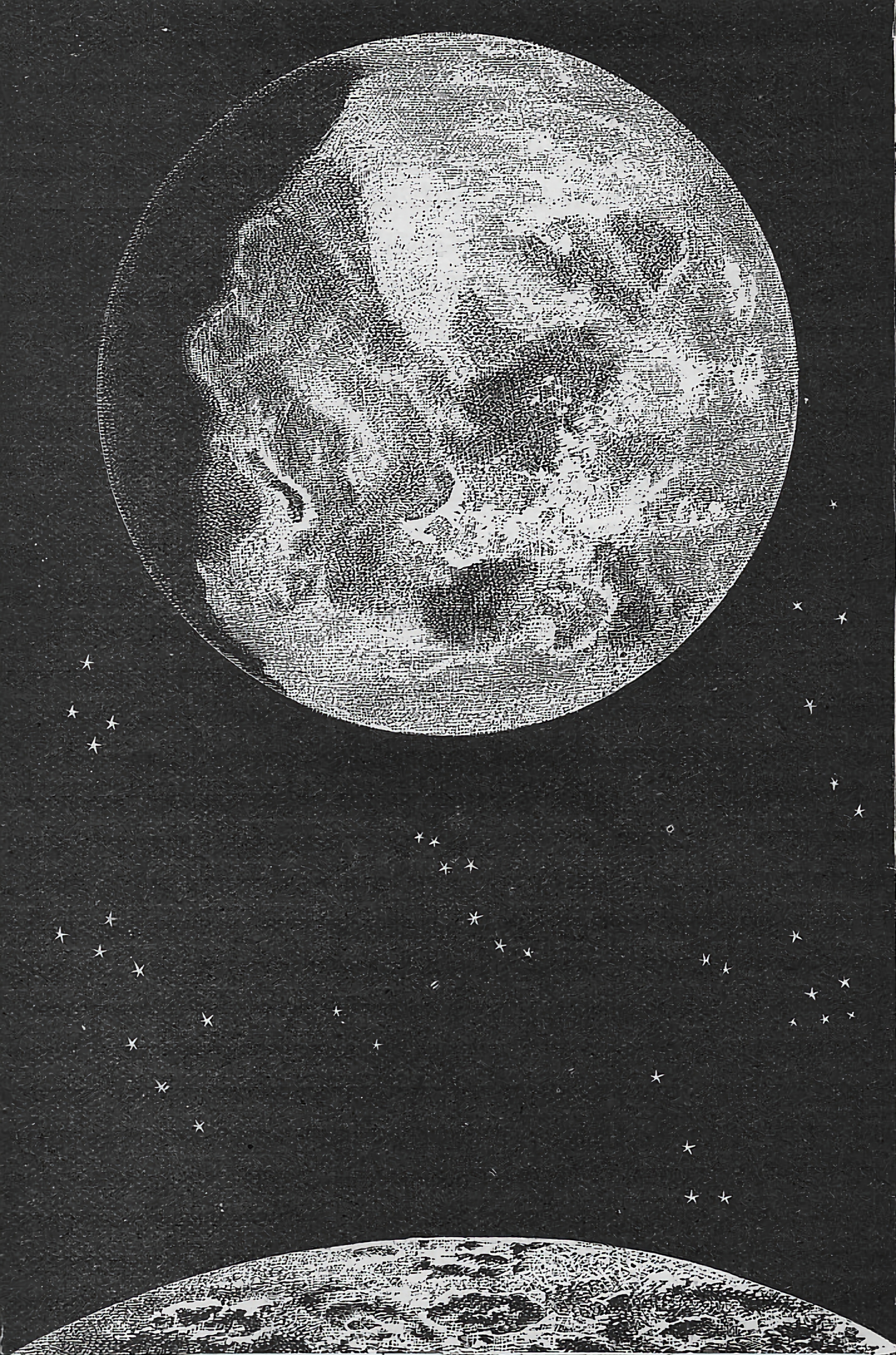 Unknown illustrator, The Earth, as seen from the Moon, 1894
Here the Moon itself enters the frame, and the image’s caption makes the vantage point explicit: we are looking at the Earth as a visitor to the Moon might see it. Though the lunar surface occupies the lower edge of the image—close to the viewer—the implied point of observation sits slightly above and behind it, suggesting a traveler in orbit rather than one standing on the ground. The compositional grammar of the Earthset image, shot from a spacecraft in lunar orbit, was already fully articulated in the late nineteenth century.
And the Earthset theme did not stall with Flammarion. It found a determined successor in the French astronomer Lucien Rudaux, whose book Sur les autres mondes (1937)—a kind of visual journey through astronomical history—opens, fittingly, with a quotation from Flammarion.
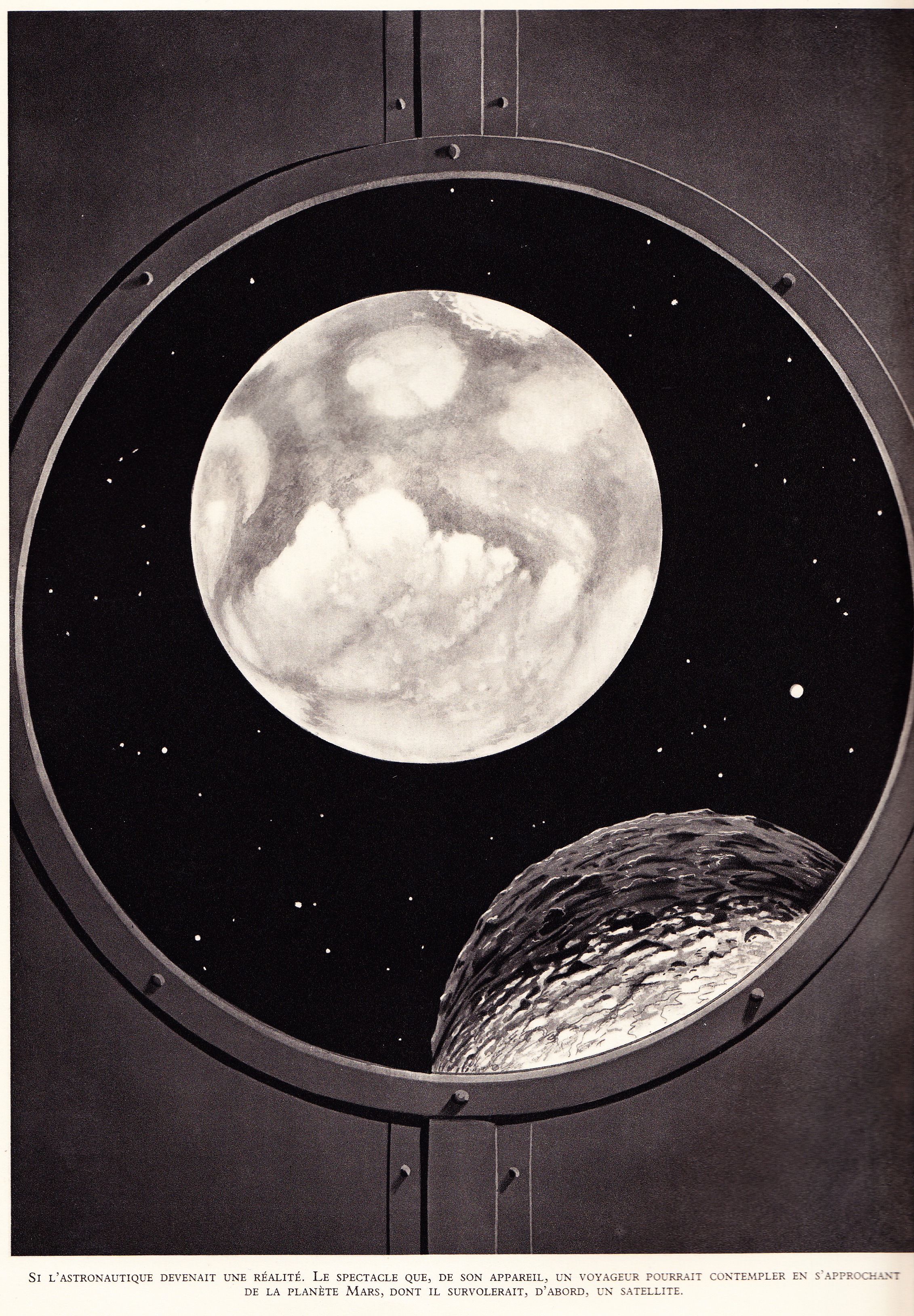 Lucien Rudaux, Painting, 1937
One of the central images in Rudaux’s book shows exactly what Flammarion had imagined: the Earth as it would appear to a visitor watching it from a spaceship situated above the Moon. Rudaux hence goes a step further. Where Flammarion had kept his observer in a kind of undefined aerial position, Rudaux places him firmly on a spaceship—a detail that obviously anticipates the coming age of (science fiction) spaceflight and the very real possibility of human beings traveling through outer space.
The decades between Rudaux and the Apollo program were, of course, not without relevant outer space images. From the 1940s onward, science fiction cinema developed its own rich tradition of Earthset-like imagery in films like Destination Moon and The Conquest of Space, building on the iconography of popular astronomy while loading it with technological ambition. That lineage connects back further still, to Jules Verne—but it is a story large enough to require its own article.
The first photographs to truly test the predictions of astronomers like Rudaux arrived with NASA’s Lunar Orbiter program, launched in 1966. The program’s official mandate was photographic mapping of the lunar surface to identify viable landing zones for the Apollo missions—a goal at once technical and strategic. But among the images the orbiters returned was something that looked uncannily familiar.
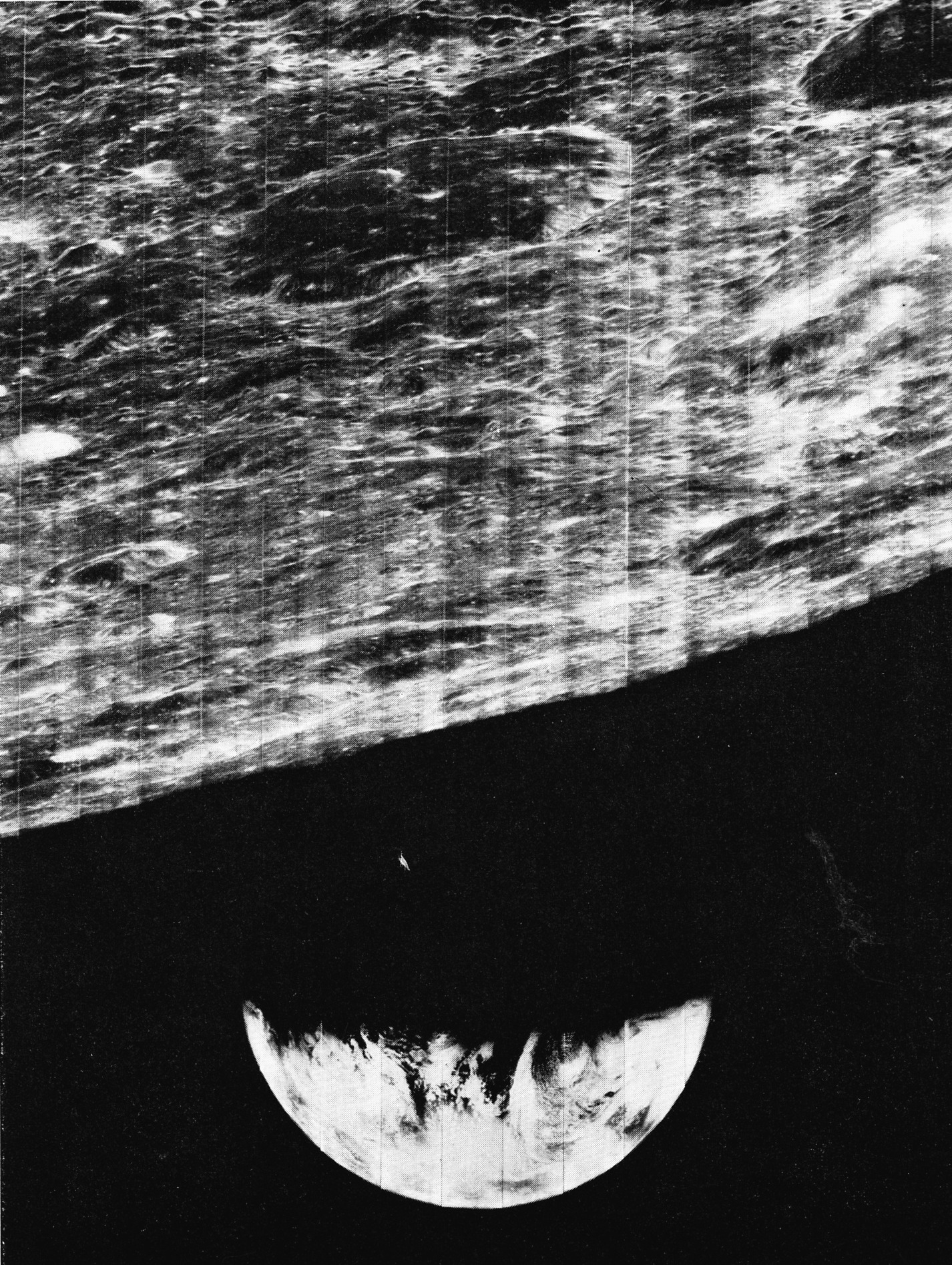 NASA, Photograph, 1966]
Seen from lunar orbit, Earth hangs as a distant crescent above the Moon’s surface. Flammarion’s speculation had become fact.
Two years later, in December 1968, the first humans traveled around the Moon. And in the course of that journey, one of the most iconic photographs in history was made: the so-called Earthrise.
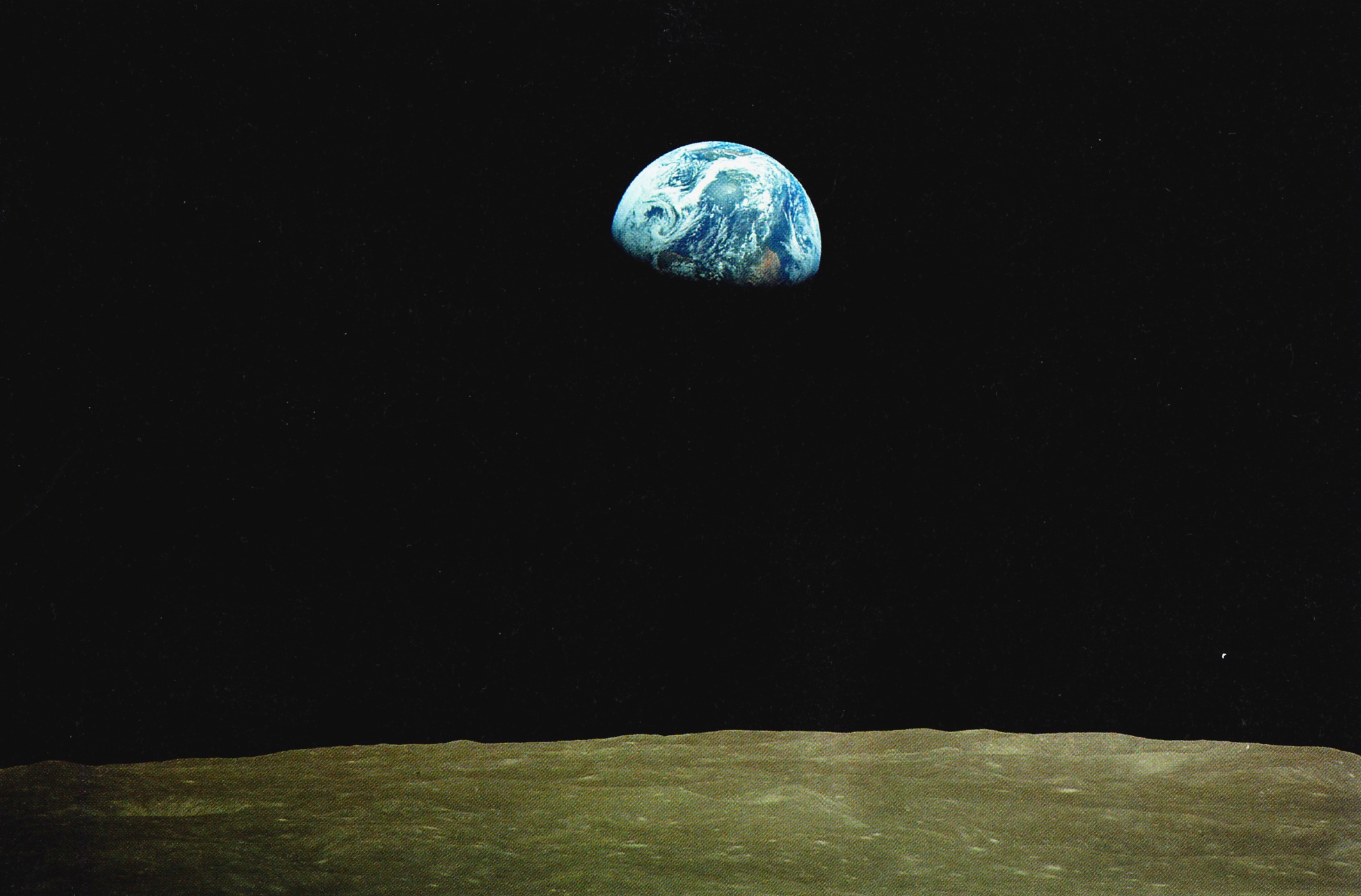 NASA, Photograph, 1968
The cultural impact of this photograph was immense. The image became a touchstone for the emerging environmental movement and a rallying symbol for figures like Stewart Brand, whose Whole Earth Catalog drew much of its philosophical energy from the experience of seeing the planet whole from space.
On the surface, Earthrise might seem to be the inverse of the Earthset motif—one shows the Earth rising above the lunar horizon, the other shows it sinking below. But the distinction is less stable than it appears. The original photograph was taken with the Earth appearing to the left of the Moon’s horizon; the canonical version we all know has been rotated ninety degrees, repositioning Earth above the horizon in a rising arc. Perspective in space resists the orientations we impose on it from Earth. In any case, the kinship between the two images is unmistakable.
What Earthrise shows, like the Earthset images that preceded and followed it, is a view that once belonged entirely to the imagination—and that now, again, is becoming real. When we look at the Artemis 2 Earthset, we are not simply looking at a remarkable photograph. We are, I would argue, responding to a visual tradition that has shaped how we expect the universe to look: a tradition constructed from centuries of longing, speculation, and artistic invention.
The way we penetrate the unknown has always been scripted—by narratives, desires, and inherited images. All of this condenses in the Earthset motif. That, more than any inherent drama in the subject matter, is what makes these photographs so powerful. The cosmos offers endless spectacles. But the images that move us are the ones that speak to something we have already, in some sense, seen before.
The Artemis 2 Earthset does not show us something revolutionary. It shows us how deeply we remain rooted in the visual languages of our past—and how those languages continue, quietly and irresistibly, to shape what we see when we look outward.