The Engine Room of Violence: Reading America Through Comics
When surveying popular culture over the past few decades, the comic genre — though few are aware of it — can be described as a kind of “meta-genre”: a form that not only produces its own stories, but continuously feeds and shapes other media. Major blockbusters of the film industry, to name only X-Men or the Avengers, were built on comic source material. And the fundamental visual style of emerging AI-generated video appears equally indebted to the hard context cuts that define the comic form. What makes the comic genre particularly significant, however, is not merely its influence on other media, but its capacity — especially in its more ambitious iterations — to sustain complex analytical narratives over years, in ways that film or television rarely permit.
In parallel, a scene has established itself in the United States over recent decades — centered around the publisher Image Comics — focused on authorship and on creative approaches to the genre. In this environment one finds not only continued radical approaches to science fiction, approaches long since lost to popular cinema. One finds equally incisive analyses of our present: critiques not only of gender roles and racism, but also of dominant narratives, of our access to concepts such as community, statehood, and identity — in a manner that seems no longer possible in other genres. It is precisely this sustained analytical capacity of the comic form that makes Undiscovered Country so remarkable a case.
The comic series Undiscovered Country by Scott Snyder and Charles Soule, which stands at the center of this essay, was able to develop its themes over seven years (2019–2026) — an enormous span of time by the standards of contemporary popular culture. And it is this influential series that has found its conclusion in recent weeks. At the center of the series stands, as the title already suggests, the search for the identity of a country — in this case the USA. What can be said against the backdrop of the series' final issue is this: its analysis of what the USA is, at a time when its inner compass has been radically reoriented, represents a statement of central value for understanding our present time.
In what follows, I plan to take a brief look at the series — one that can in no way do justice to its aesthetic and artistic value — and to place its engagement with the present at the fore. I plan to show how the series develops conclusions that help us better understand the developments of our time. Against this backdrop, a spoiler warning must also be issued here. The series will be approached without regard for preserving the reading pleasure and suspense of the final ending for potentially interested readers. I ask comic enthusiasts to forgive my reading and mode of analysis.
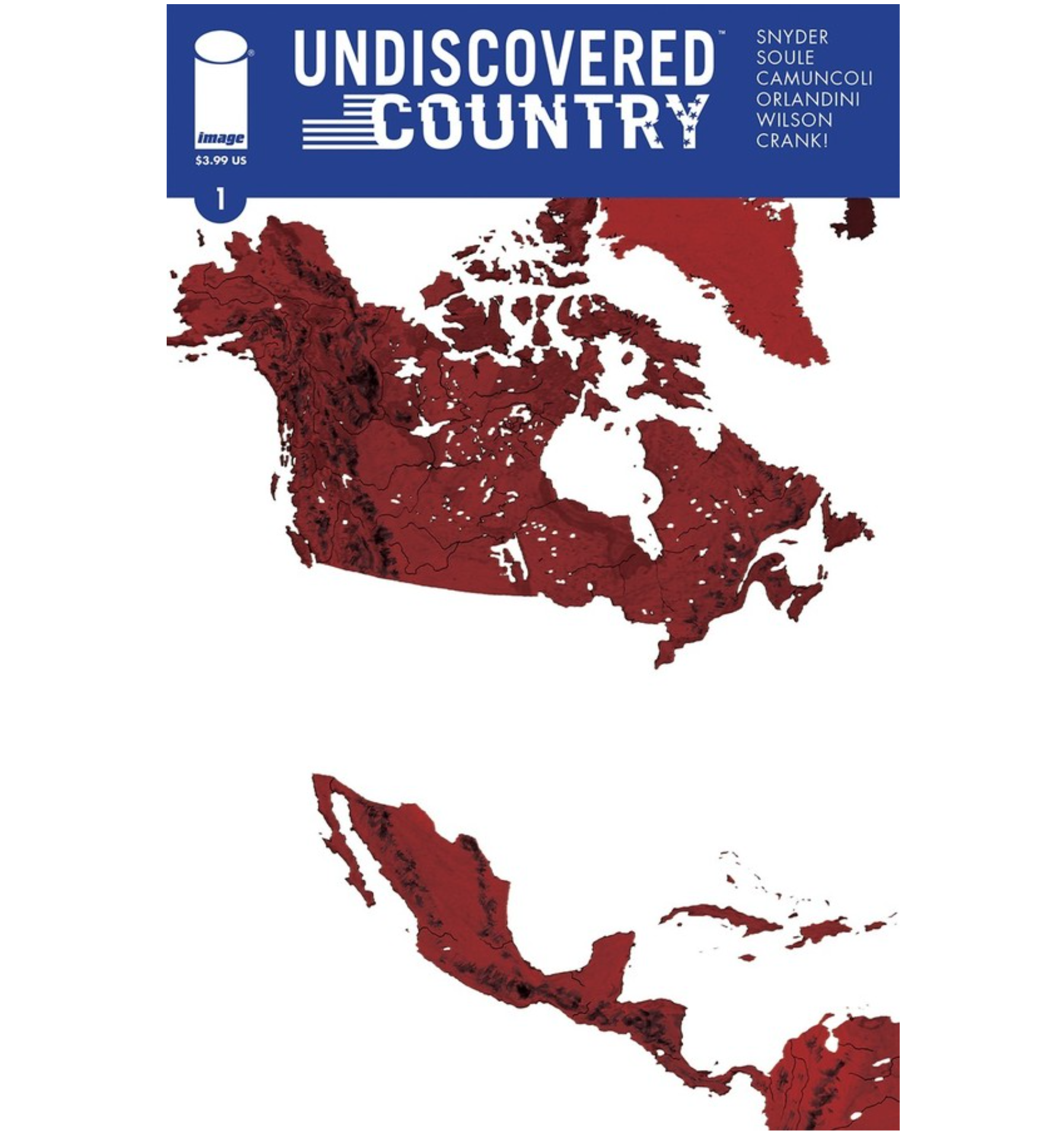
“Journey into the near future, and an unknown nation that was once the United States of America — a land that's become shrouded in mystery after walling itself off from the rest of the world without explanation over thirty years ago.” This is the basic introduction to be found on the official website of Image Comics for Undiscovered Country. The storyline places us in the near future, in which the USA has decided to seal itself completely from the rest of the world. We are introduced to a time in which a global pandemic has devastated civilization and new superpowers and alliances are competing for dominance. At precisely this moment — thirty years after the complete withdrawal of the USA — a message reaches the outside world. A cure for the pandemic may be available within the United States, and new trade agreements might be possible. Against this backdrop, an expedition is assembled to visit the now unknown United States. The storyline begins with the introduction of seven persons brought together for this expedition and accompanies them on their journey through a land that was once known as the United States of America.
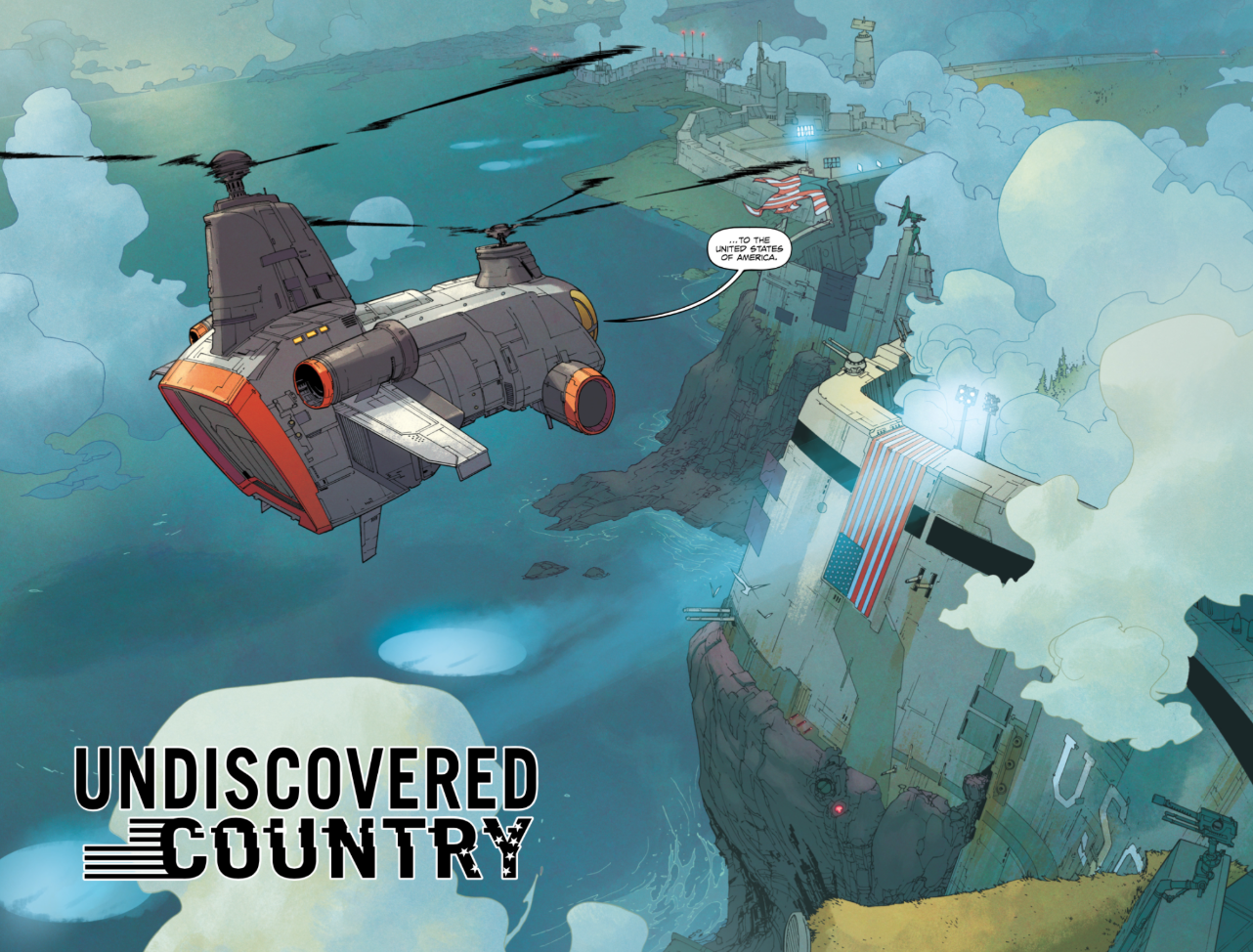
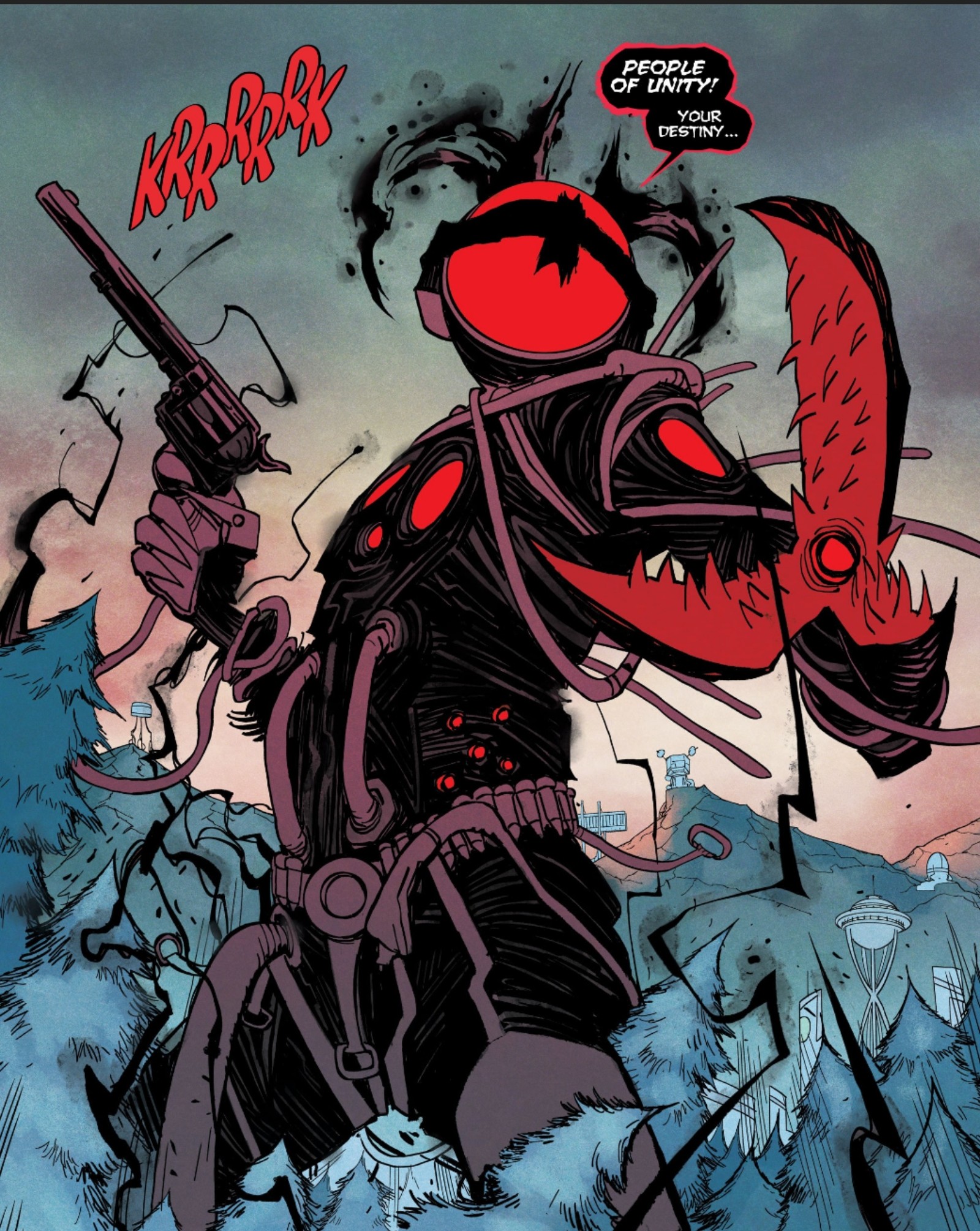
Across a total of thirty-six issues, this expedition group is accompanied through the USA. What the group quickly learns is that the USA has been internally transformed into a series of zones — seven in total, each governed by a dominant idea in American culture. Of these, two are particularly central to the series' analytical ambitions and will be examined here in greater detail. “Unity” pursues the vision of digital technology to its radical conclusion. “Destiny” — closer to the Wild West — is a place in which the personal pursuit of happiness, freedom, and self-invention is practiced with terrifying consistency and violence. What distinguishes all the zones of the new America is a rupture between a fascinating surface and a deep corruption that has taken hold within. On the journey we learn ever more about the ideologies that determine the new America and the deep fractures and abysses that manifest within them. Along this path we further learn that the USA has long been taken over by a supercomputer called “Aurora” — not merely a backdrop, but the story's central dramatic force, orchestrating the entire journey from behind the scenes.
The adversaries the group encounters are drawn as extreme caricatures. A full account of the series' characters lies beyond the scope of this essay. Two, however, demand closer attention. The “Destiny Man” accompanies us through various narrative turns until the very end of the storyline. He is a figure of radical self-transformation and capacity for violence, a hunter who in the course of the story increasingly begins to determine the fate of the expedition group.
Equally characteristic for the course of the story is the mistress of the “Unity” zone, Dr. Naira Jain, who initially greets the visitors with warm hospitality.
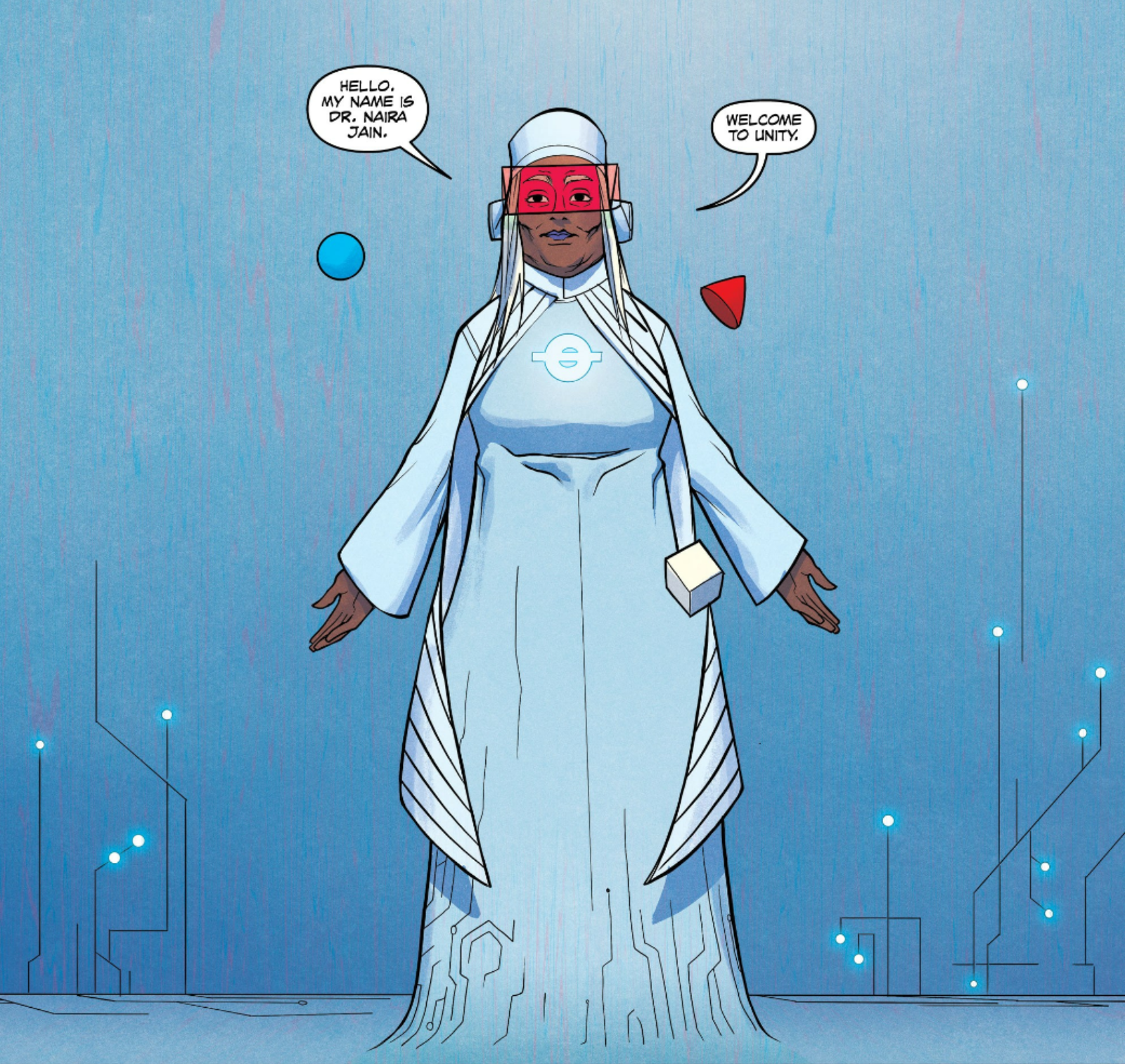
As with practically every first encounter in the zones, Jain appears at the outset almost clichéd in her friendliness. She presents the achievements of her zone in convincing terms. The storyline in Unity, too, unfolds as a slow and steady demystification — the unmasking of a toxic narrative. At the end of the journey through Unity we must learn that the glittering digital surfaces were mere appearances. Beneath them, nothing but bare violence against children and bodies is to be found. It is also from Jain that we learn the true character of the new America. The country has been transformed, as she explains, into a gigantic computer designed to process all local knowledge in order to enable global insights into the nature of existence.
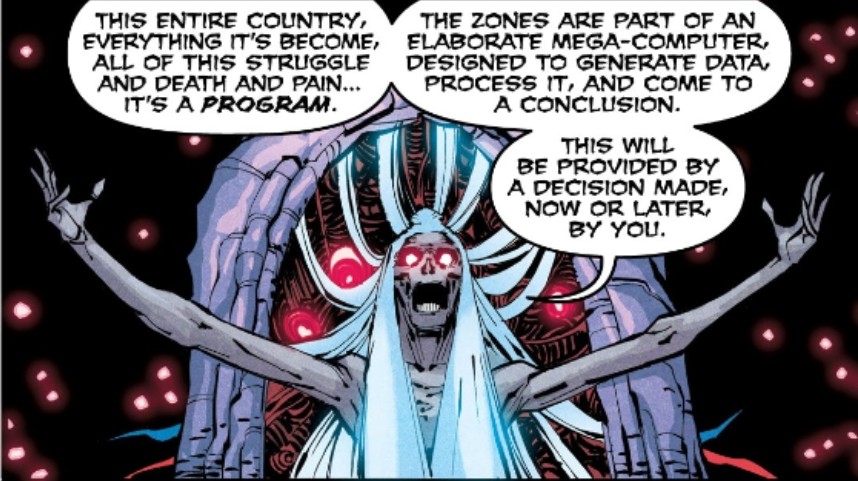
As the story progresses, it becomes ever clearer that it is the expedition group whose insights Aurora has been waiting for all along. Their accumulated understanding, gained through the journey across the different zones, is meant to provide Aurora with the final impetus to answer the question of what America actually is — what this country, this idea, is defined by at its core. It is at this point that Aurora steps fully into the foreground: no longer a system governing from a distance, but an active interlocutor demanding an answer.
And here we arrive at the analytical core of this story. The zones themselves are not merely plot devices; they are arguments. Each one stages a dominant strand of American self-understanding and exposes its internal contradictions. At all the exaggeration of its characters, the series commits to a critical analysis of what constitutes contemporary America. Dominant narratives are unfolded and the underlying horrors exposed. Against the backdrop of current political and cultural developments in the United States, lines of discourse are traced here that help us understand what we are dealing with: a country that has, in essence, set out searching for its identity.
The comic expedition's search leads finally to the moon, to which Aurora, as we learn, has retreated. The location of the moon serves not only as a reference to one of the greatest achievements of American history — the first moon landing. It also symbolizes the existential distance that Aurora's technical presence has taken from its actual subject: the United States of America. On the moon we encounter the supercomputer in various guises. It speaks of the end of America's narrative and asks simultaneously how that narrative might be continued.
Aurora's visual representations shift from exaggerated depictions of historical figures —
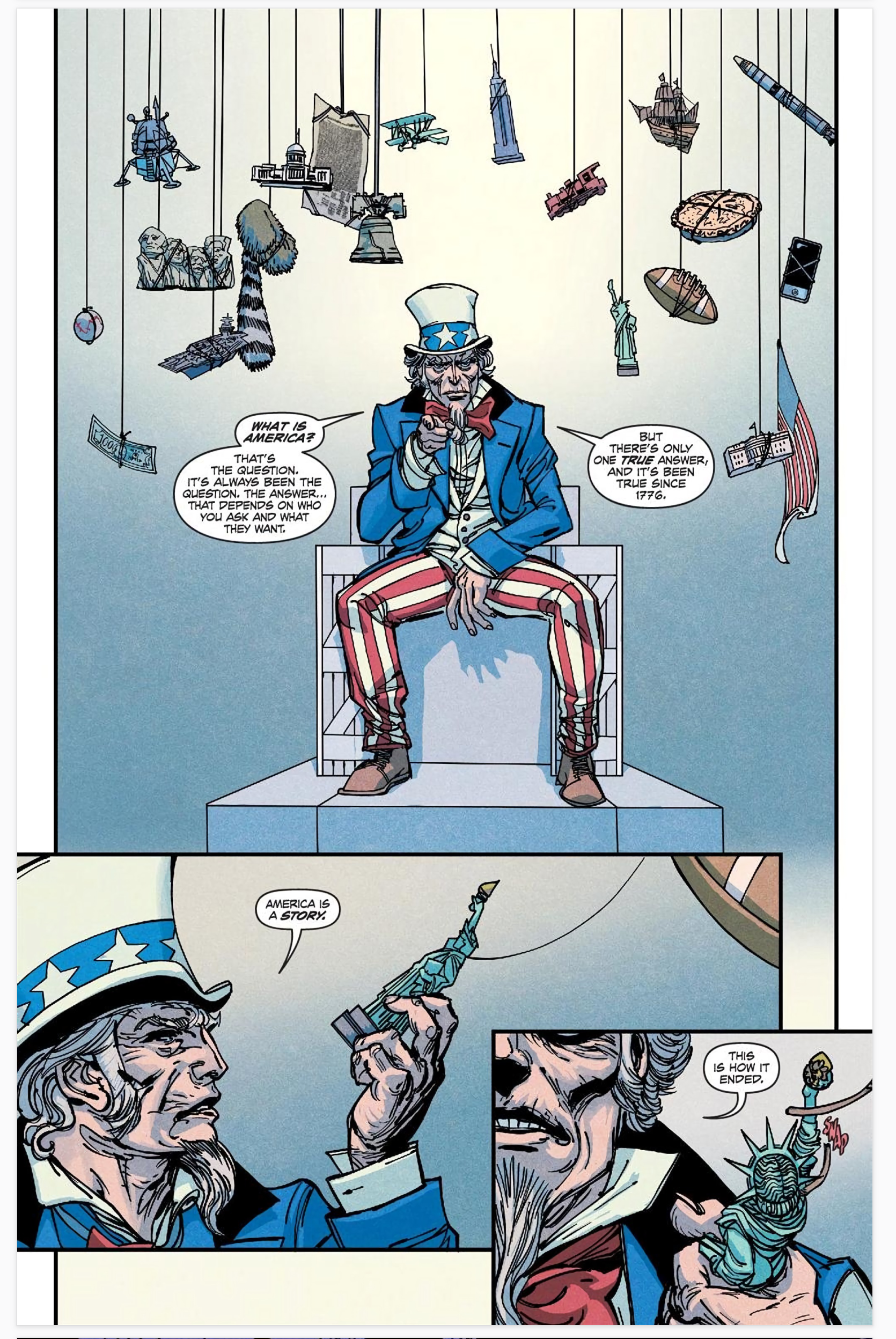
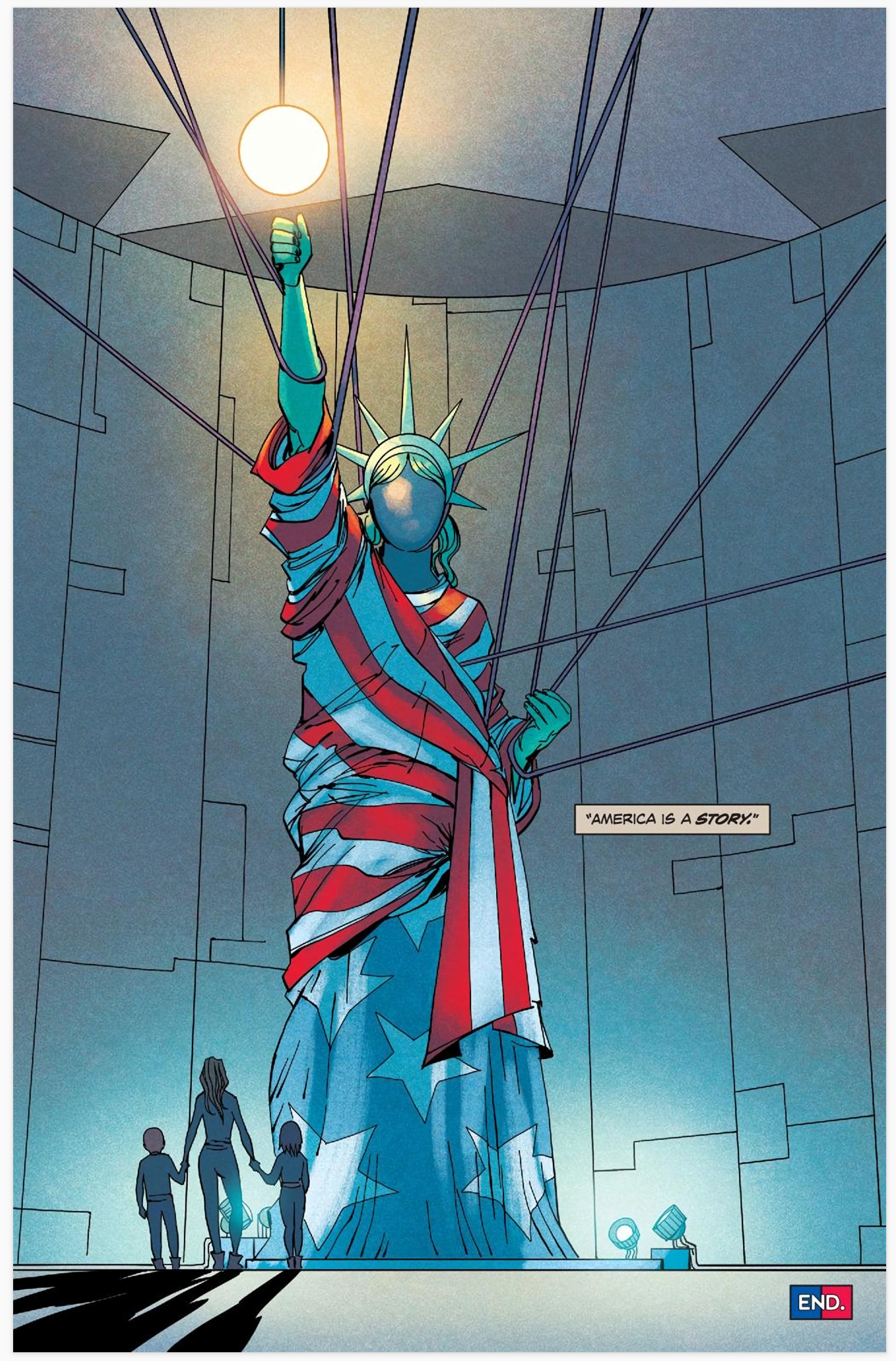
— to technically bastardized adaptations of the Statue of Liberty: a robotic entity in the body of the statue, formulating its central question with forceful insistence.
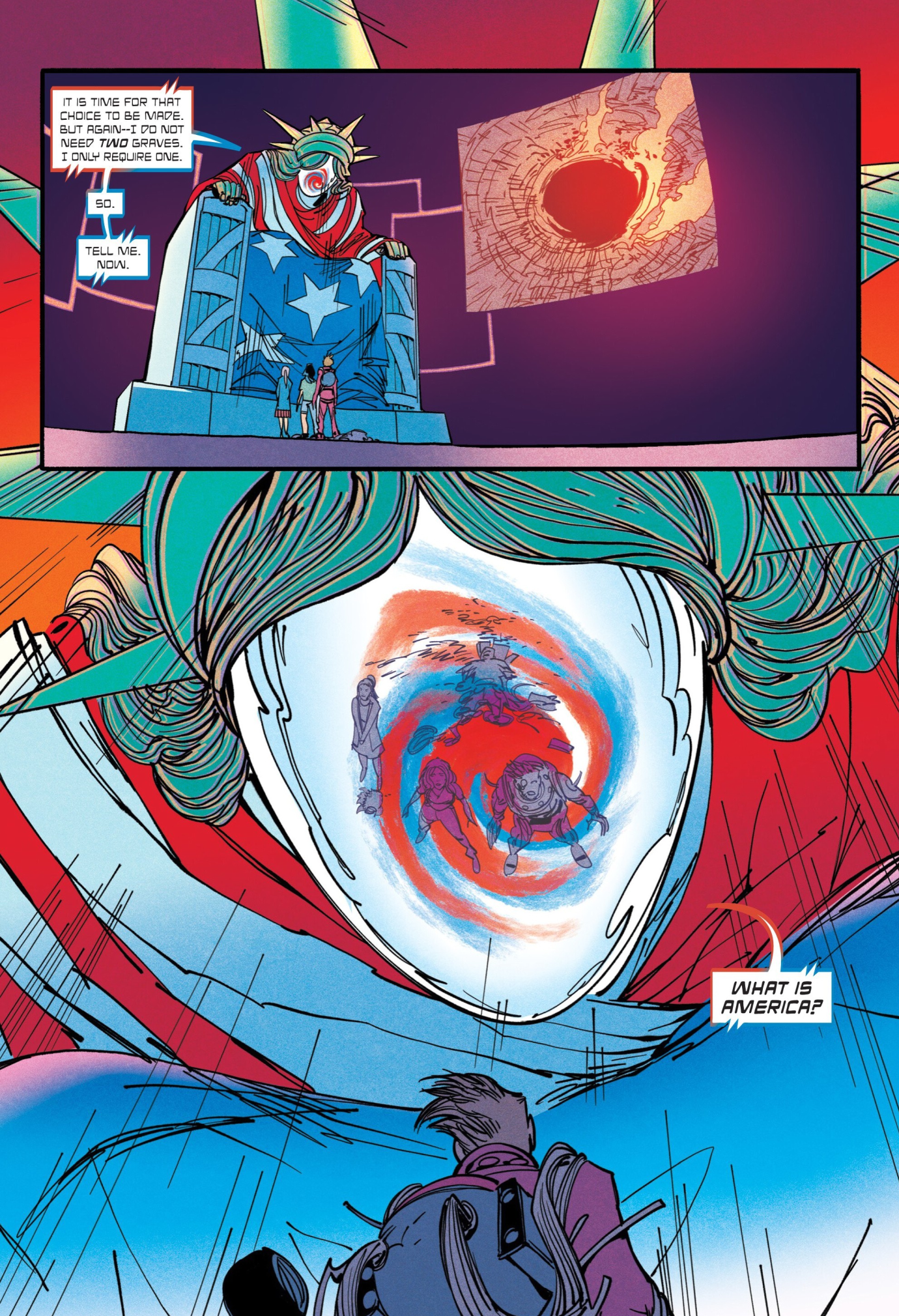
Over the answer of the expedition group — and over the question of who among them is entitled to give it — a struggle breaks out in the final section. It arrives at no conclusion capable of satisfying us. The Destiny Man, now transformed into a human body, declares that conquest and the projection of power stand at the center of America's identity. That this answer does not lead to catastrophe is due solely to the fact that two members of the expedition have, over the course of the journey, gradually learned to develop their own narratives of love and care — one might speak here of counter-narratives. Among them is the group's journalist, whose role throughout has changed from observation to poetic action. It is they who, having learned to tell a different kind of story, ultimately penetrate Aurora's engine room and sever all lines of connection and control running toward Earth.
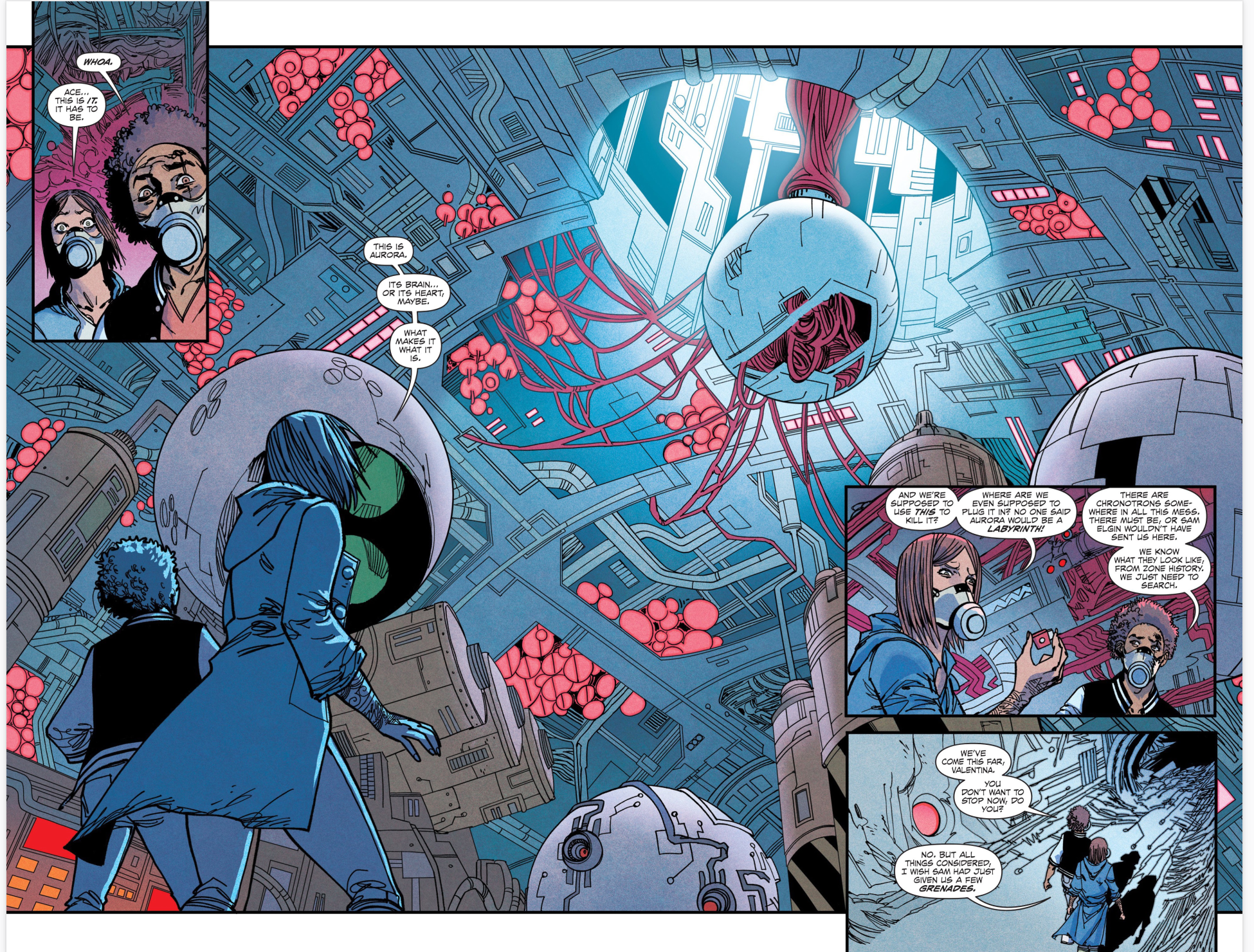
Isolated on its lunar machinery, Aurora finally recognizes that it can no longer fulfill its mandate to redefine America and shuts itself down. The potential catastrophe is averted. The present is once again transformed into a space for the inhabitants of America themselves to shape.
The statement that can — and must — be read from Undiscovered Country is unambiguous. The question of whether America's narrative is a toxically dangerous one for humanity is marked as secondary. Where the danger lies — and this thread runs through every issue — is in the smooth surfaces, in technological visions that claim universal validity. So long as it is technology that defines which narrative about the United States prevails, we remain in danger of a violently inhuman reorganization of our present. It is individuals who regain control over their own narratives — who refuse the stories handed to them and develop, together, something harder to systematize: stories of love, of care, of mutual responsibility. It is precisely they who prove capable of penetrating the engine room of violence and preventing catastrophe. The series is insistent on this point: collective stories of love and care are not a soft alternative to emancipatory action. They are emancipatory action.
The question that technology poses to us is identified in Undiscovered Country as a question about the great whole — about what we are, what we want, and what kind of world we are prepared to inhabit together. And more important still: it is not the answer that prepares the way toward emancipation, but the recovery of our capacity to ask — for ourselves, without intermediary. The series suggests, quietly but insistently, that any system which takes that capacity from us is a form of dispossession. The series' engagement with the present can thus be read as an urgent call for human self-interrogation and self-emancipation. America's tragedy is located, at its core, in having submitted to a technical redefinition — and in the failure to meet that redefinition with a living counter-narrative of its own. At a time when AI systems and algorithmic infrastructures not only filter information but increasingly set the very conditions under which political identities come into being at all, this is more than a literary motif. It is a diagnosis.